Royal Doulton Artist Profile – George White

George White 1885-1912

The choice of artist profile for this post, was an easy one given the choice example of White’s work coming up this Sunday at Lion and Unicorn Auctions in Florida.

In today’s world White is regarded as one of the greats from the Burslem studio, moreover the top of his particular field of figure painting. Like another Doulton great, Hannah Barlow, he too was the product of the South Kensington and Lambeth Art Schools. Doulton themselves recognised his talents early on in his career there with his work taking prominence in any exhibit of the time. In the book ‘The Royal Doulton Artists’ Owen attests “In portraiture White attains the happy success of not only ‘catching’ the likeness of his subject but in seizing and expressing personality – the supreme test of the portrait painter.” True praise indeed from 1910 by Owen, but this sentiment was also reflected by Sir Henry Doulton who White painted, along with his brother James and other Burslemartists of the period. 

That other Royal Doulton legend, Charles Noke said of White ‘…not only did he depict the human form divine with beauty, grace and delicacy, but he…. also brought out the individual personalities of his models. 

A cursory glimpse through the Royal Doulton paper archives illustrates the position White was held in, as you see his name next to many important exhibition vases with the words ‘Figures by Mr. White’.

White painted one of the famous Diana vases for the 1893 Chicago Exhibition and also a Dante vase in collaboration with Chares Labarre. In the Doulton Burslem wares book Desmond Eyles notes that a large vase by White titled Titania was made specifically for Prince Rajitsingh. 

The variety of ladies painted by White be they fanciful, allegorical or otherwise remain among the most prized items by collectors today and his work regularly sets the auction world abuzz. White’s ladies clad in diaphanous clothing have retained all of their original appeal and with titles including Sleeping Beauty, The Dance, Orpheus and Eurydice, Cupid and Psyche and Spring Frolic we today adore his work in equal measure to his contemporaries.

Whilst he will always be remembered for his freehand painting, White also contributed designs for more mass production at Burslem and these typically carry a GW number on the base. Other alternate markings indicating some transfer with overpainting by White and these include George A. and also A. Dix was a popular pseudonym of his.
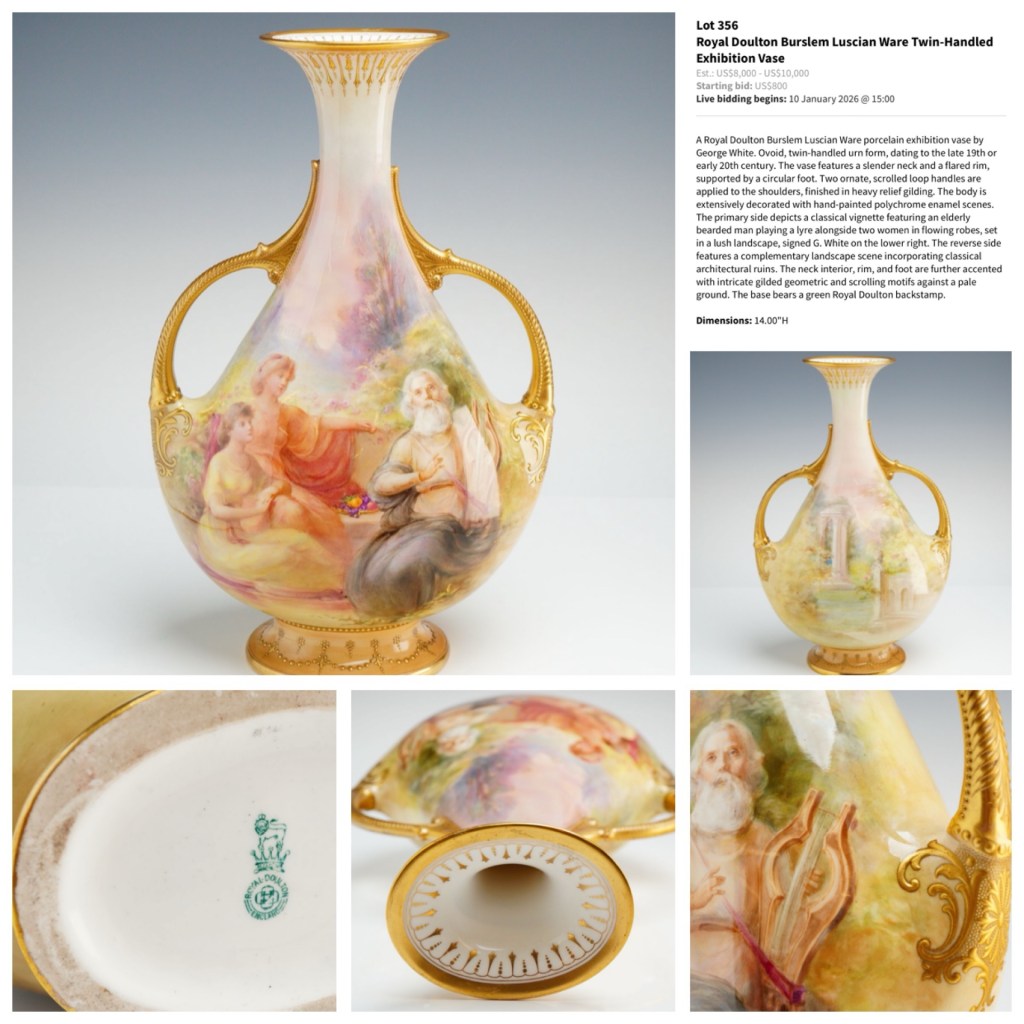
As for inspiration here is the aforementioned case by White…delectable charm on fine china!

@


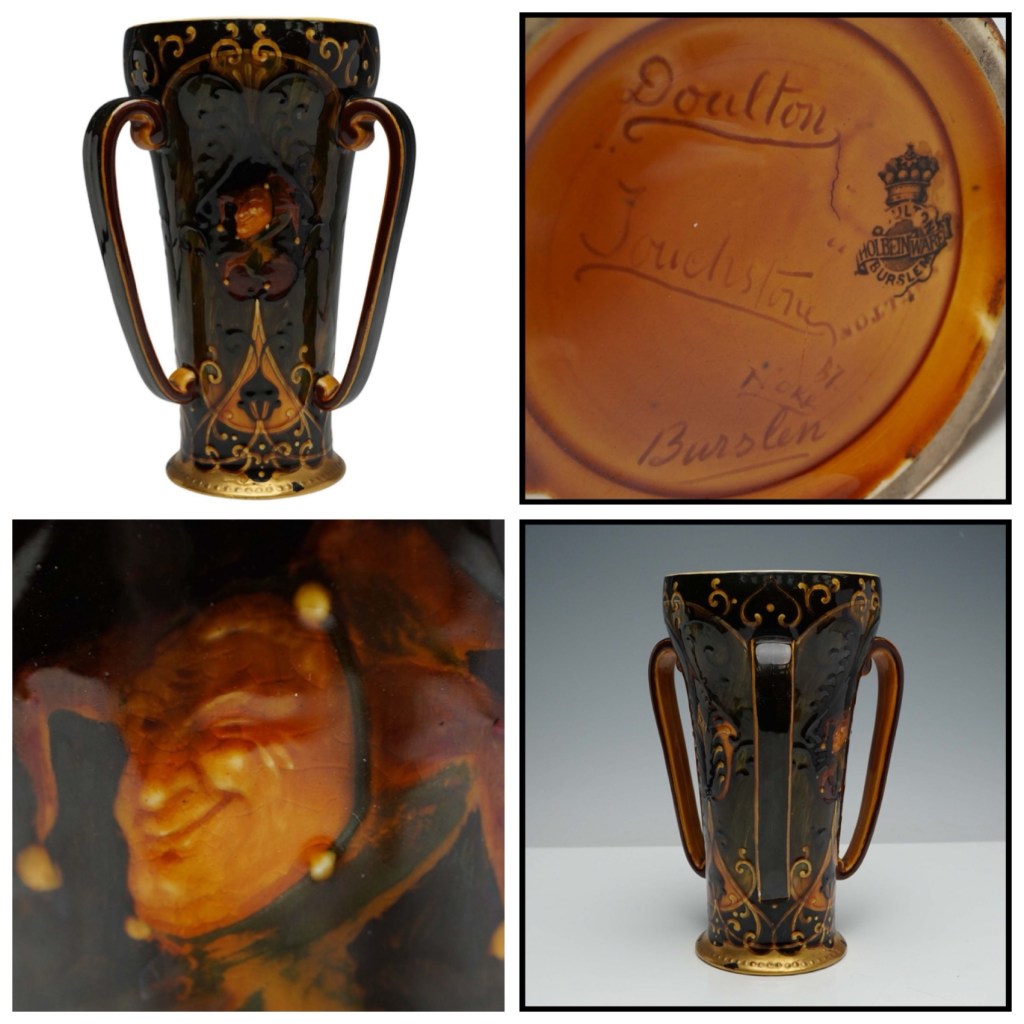
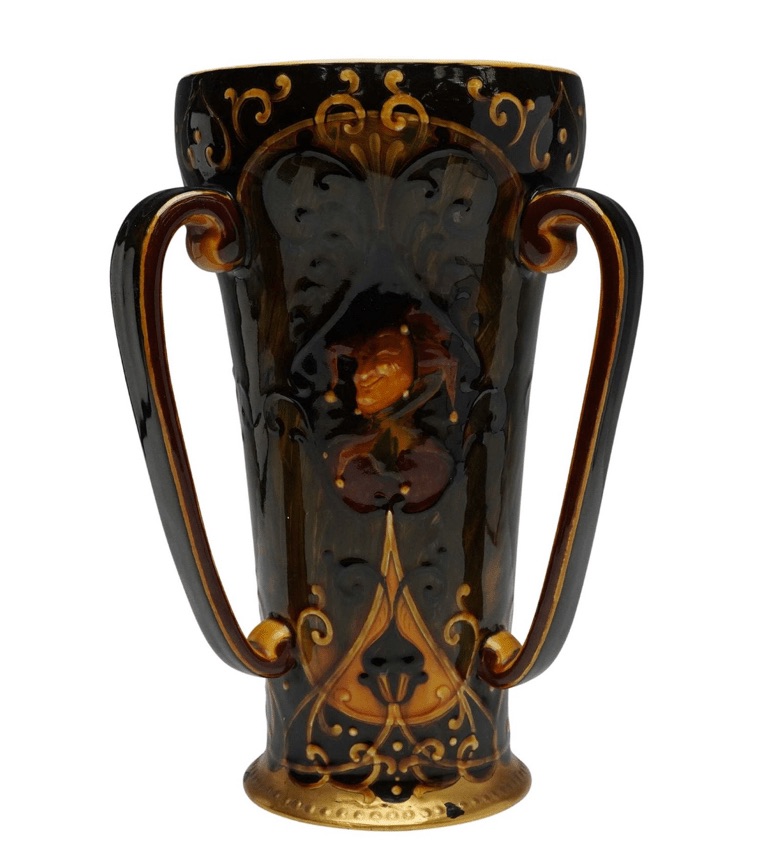
A Unique Holbein Jester Tyg by Noke

The legendary Burslem art director, Charles Noke, had a long fascination with Jesters as seen by any cursory glance through the Royal Doulton ranges of yesteryear – from the later 19c Vellum figures ‘The Jester’ and ‘Mirth and Melancholy’, to character jugs including ‘Touchstone’, to unique art ware pieces such as this Holbein tyg by Noke himself. 

This particular piece is a one-off example by the art director himself and dates to the 1890s. All decorated and painted by hand, I haven’t seen the same shape with this character before.

The character in question is Touchstone, that most famous of court jesters featured in Shakespeare’s ‘As You Like It’. He is a court Jester, used throughout the play to both provide a public voice of reason or challenge, and humour, sometimes vulgar humour, fitting the archetypal Shakespearean fool. 

Around the turn of the 20th Century there were many exciting introduction at Doulton’s Burslem studios, many the brainchildren of the famous Charles Noke. Holbein ware (1895-1915) is a typical example of Noke’s experimentation with glazes and bodies. Holbein wares give the impression of old masters through the use of yellow, green and brown slip on a cream earthenware body. Portraits on these vases were typically by Harry Tittensor and Walter Nunn among others. Incidentally this name of ware was also given to a series of items of art nouveau shape including candlesticks and oil lamp bases. Further Holbein pieces not featuring portraits but rather nocturnal animals including owls also appear. This ware had a special backstamp but it was not always used, creating certain confusion about this particular ware. This ware should not be confused with Rembrandt ware.

Thanks to Lion and Unicorn Auctions for use of the images. This lot is coming up 22 June 2025 @ 17.00. 

An early prototype coming up at Lion and Unicorn Auctions

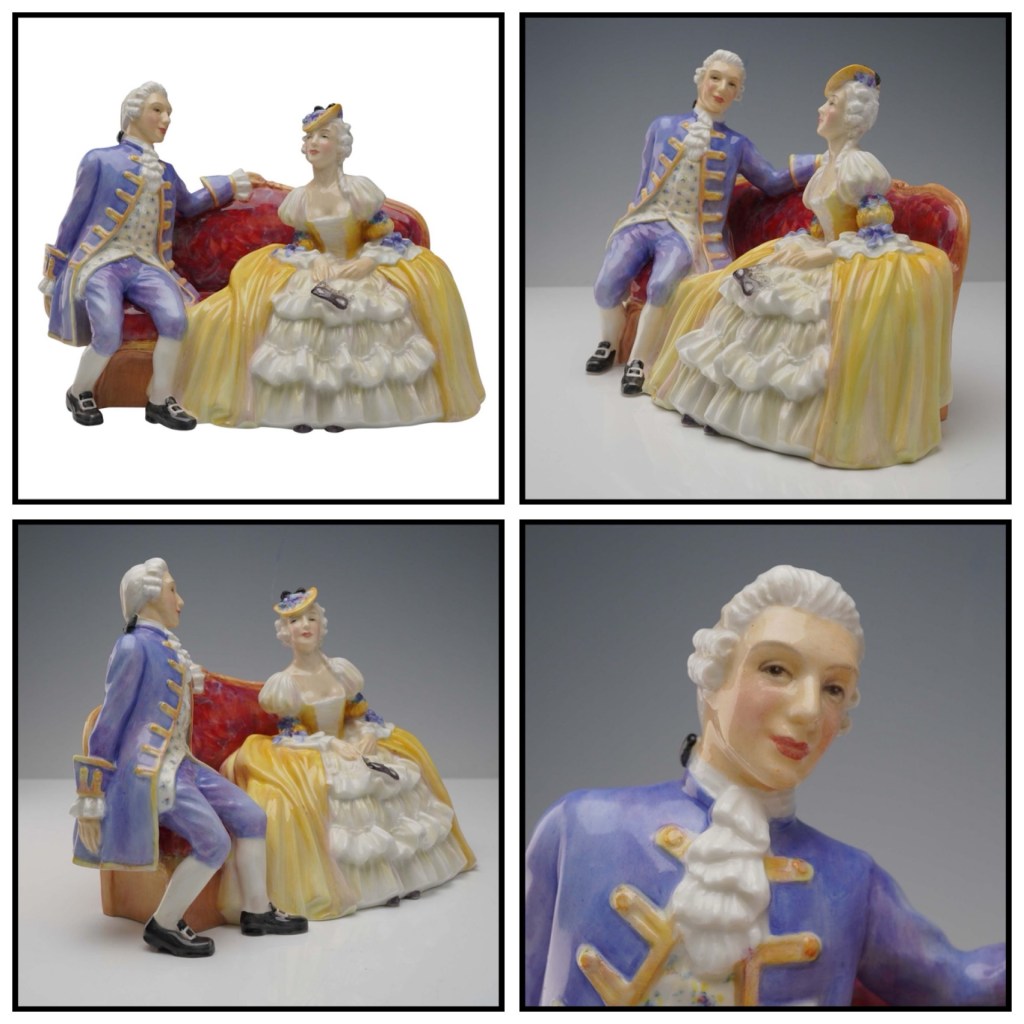
One of the star lots next weekend is this early prototype of the figure that would become Belle o‘ the Ball HN1997. 

Modelled by the talented Roy Charles Asplin, this early prototype version was blocked in June 1945, this month marking its 80th birthday!  This prototype is model 1275, whereas the version produced without the man and the Belle in different colours was model 1286, indicating that the original model was swiftly disgraced and swiftly remodelled without the male figure.  Interestingly the produced model of just the ladybug the sofa was not introduced until 1947. 

This delightful model makes perfect sense with the Belle and her suitor paying court to her! One can trace this model not only through a late 1930s blocking book but also the original shape model book. In the latter, one can see that the number 1275 was soon reassigned to one of Peggy Davies‘ small pig models. 

As with all prototypes the modelling is not only crisper but the detail in the painting is exceptional, as these prototypes were painted only by their most established and trusted artists. 

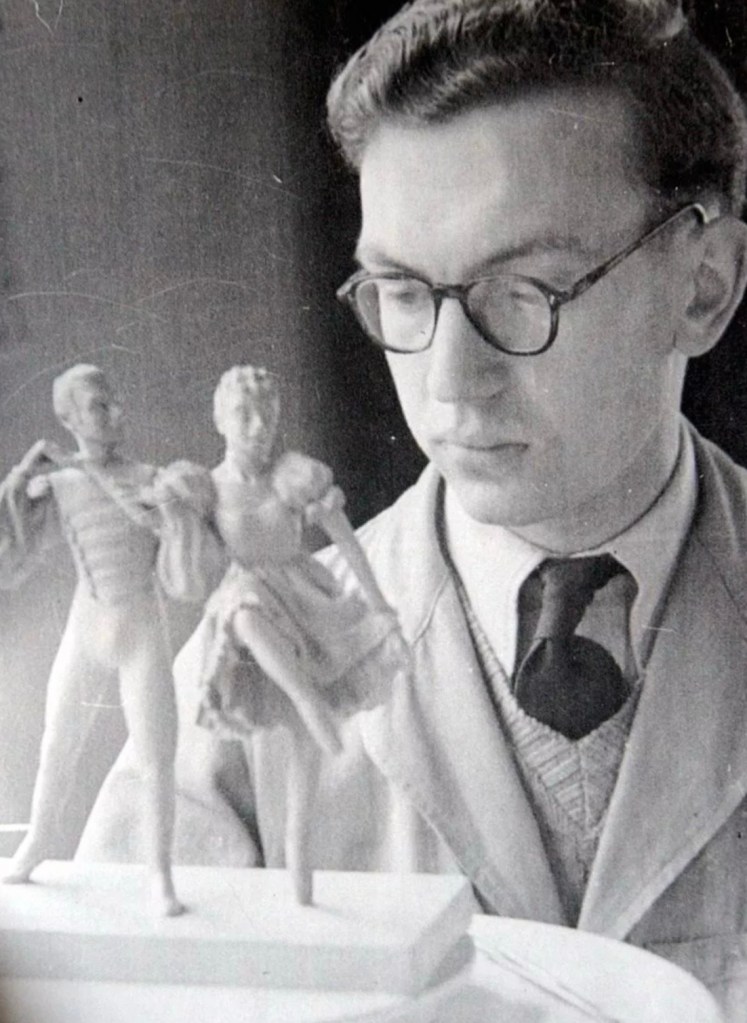
Roy Charles Asplin is perhaps not a name many know in connection with Royal Doulton but he was in fact apprenticed to the company before emigrating to Canada where he lived out his life until 2014. Born in 1925 in Hanley, one of the famous Six Towns that make up Stoke-on-Trent, his years with Royal Doulton set his career path as he continued to model and produce figures as well as character jugs and even statues. His style of Royal Doulton figures is quite different to his contemporaries Leslie Harradine and Peggy Davies, and here is a photograph of him from 1943 at the age of 18 modelling a further prototype duo after the ballet stars Moira Shearer and Alexis Rassine.