An interesting booklet ca.1949 explaining how The Potter is assembled using 15 different parts!
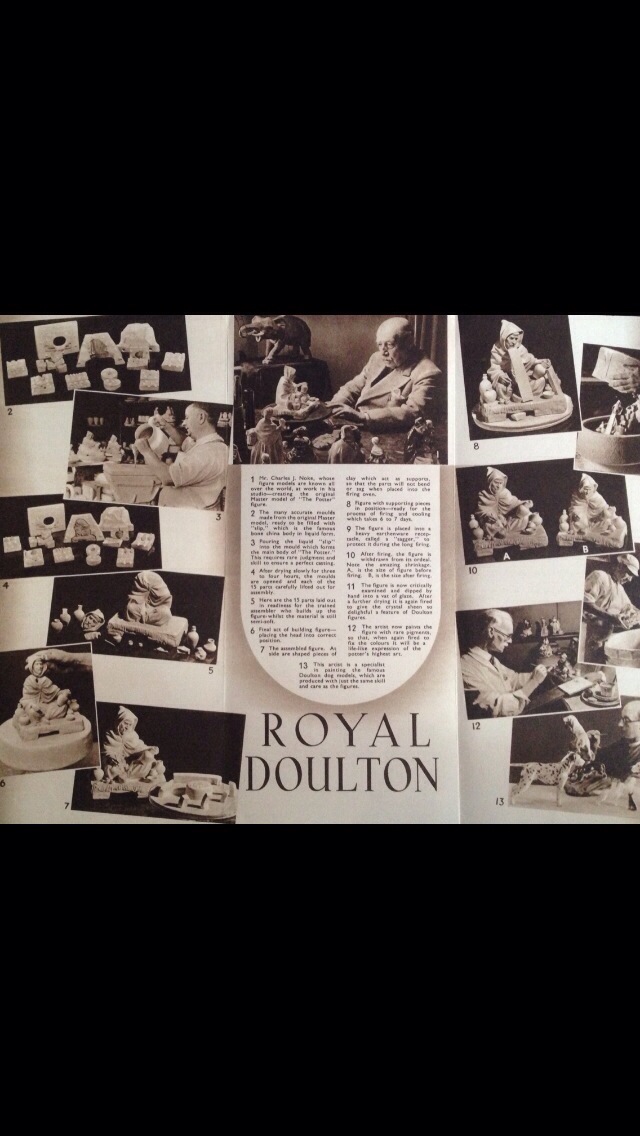
An interesting booklet ca.1949 explaining how The Potter is assembled using 15 different parts!
With so many collectors of Doulton’s famous Bunnykins nursery ware out there, it is hardly a surprise that it reamins a popular line to this day. Originally created by Barbara Vernon (she took her mother’s surname when she became a nun) in 1934 and famous patrons of this ware have helped perpetuate its success.
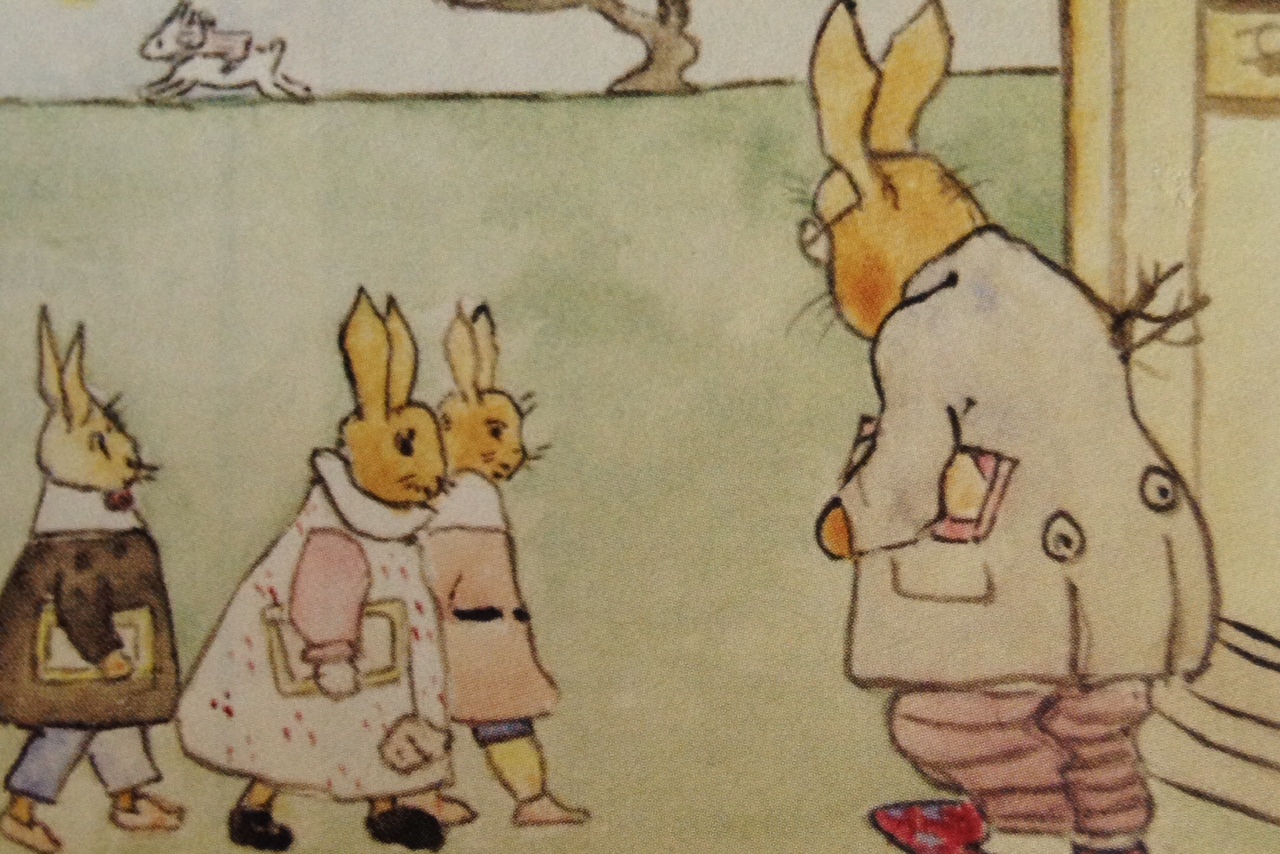
An example of an early pen-and-watercolour illustration by Barbara Vernon (1930)
In 1937, the late Queen Mother first saw examples of Bunnykins and since then it has been a regular in Royal nurseries around the world. Interestingly, Barbara was actually the daughter of Cuthbert Bailey, the manager of Doulton’s Burslem factory and hence the Doulton connection.
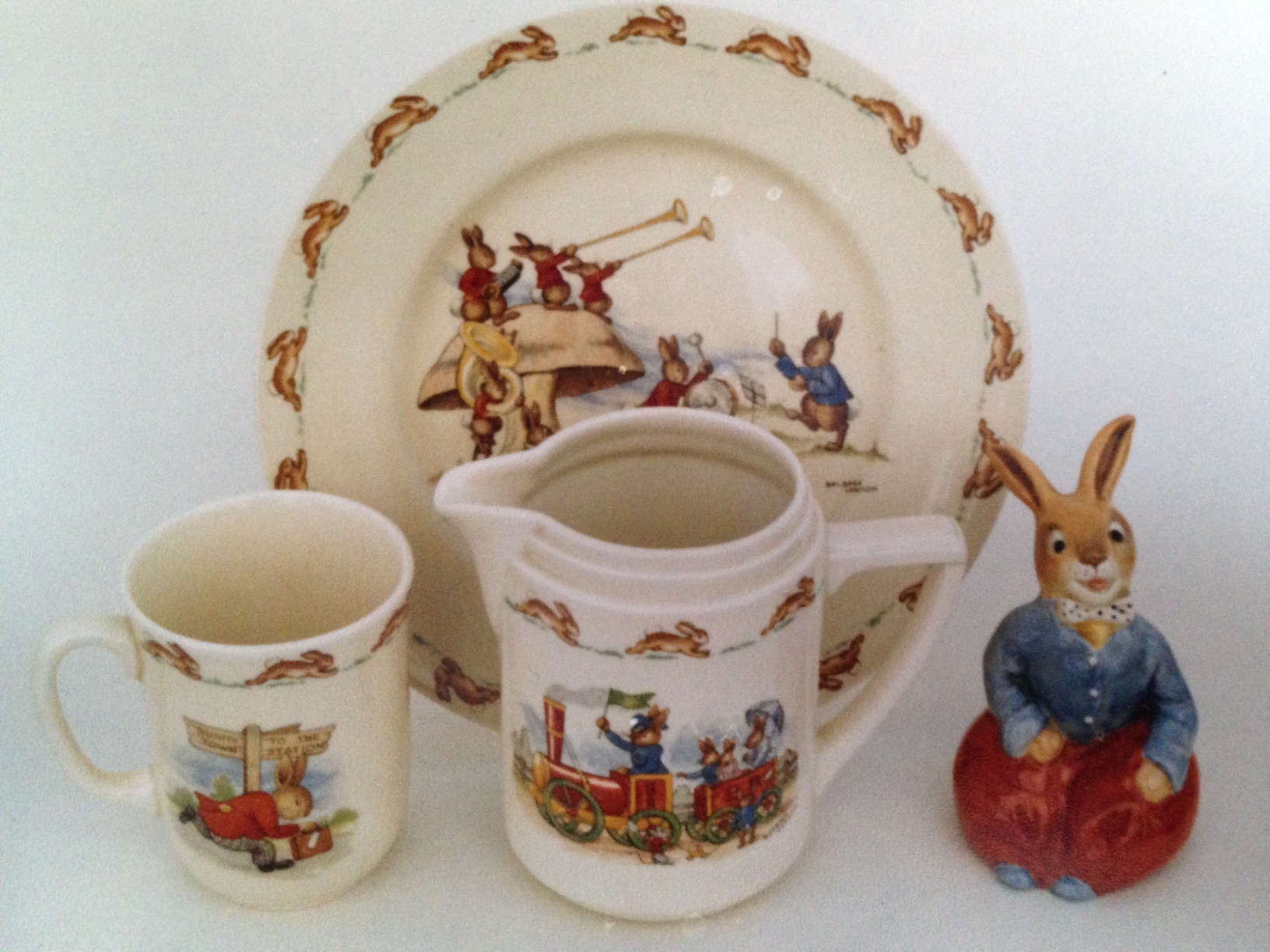
Examples of nurseryware and the rare Billy Bunnyking
Due to failing eyesight Barbara’s creations for Doulton curtailed in the late 1940’s and Walter Hayward took up the reigns and designs of this most famous nuersery ware continue even to this day. At the most recent Doulton fair here in the UK, once again there was a special limited edition piece, a Bunnykins figure commissioned by Ceramics International for the event and of course it was another sell out!
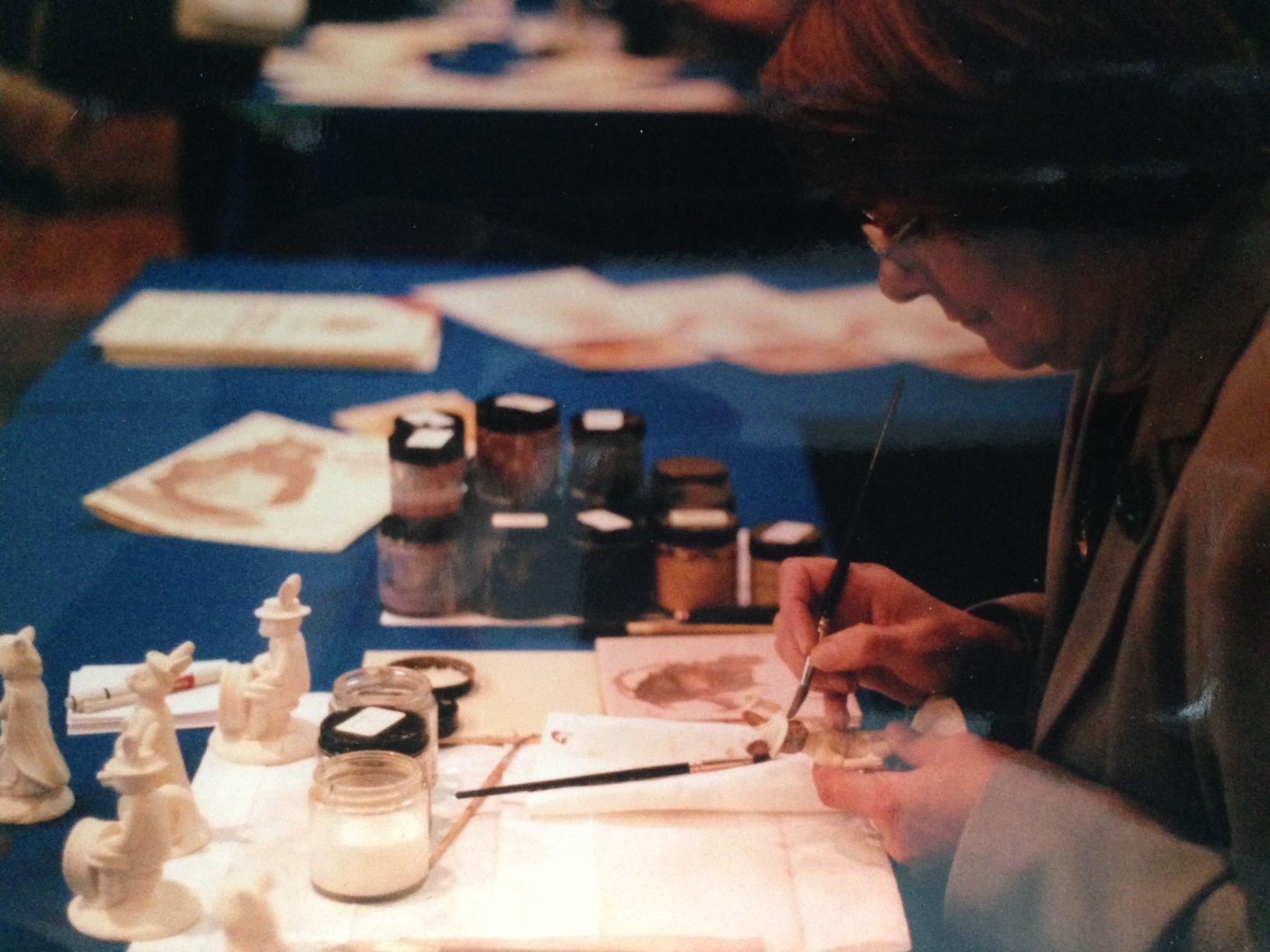
Bunnykins figures being decorated
Here you can see a picture of the various backstamps used on Bunnykins over the years. Of interest to collectors of nurseryware itself are the signed pieces by Barbara Vernon. Walter Hayward, rather than use a facsimilie signature used a mouse to indicate his designs.
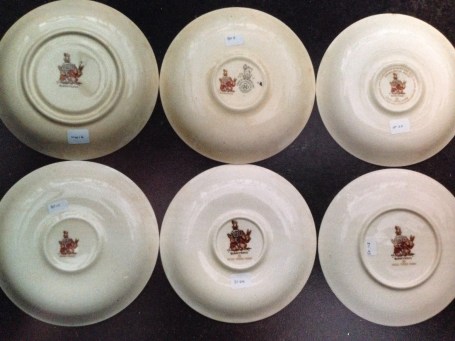
Examples of Bunnykins nurseryware backstamps
The range of early Bunnykins figures are charming with their doleful eyes and there is an early range of tableware with modelled heads to compliment these figures. These modelled pieces of tableware are extremely rare and very popular with collectors today.
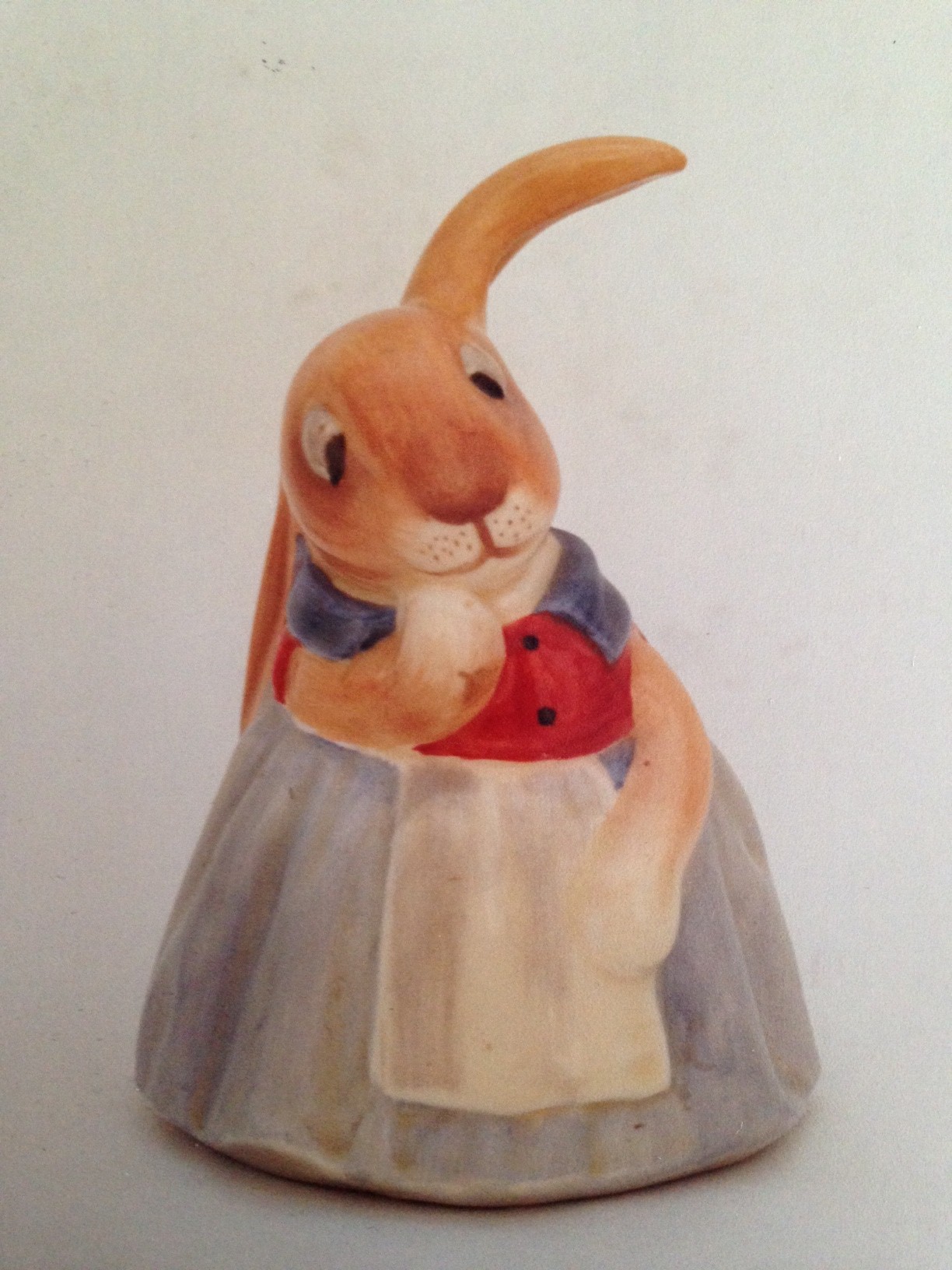
The rare and ever popular Mother Bunnykins
As with all things Doulton colourways and prototypes dominate this field of collecting. Yet, there are many variations to be found more modestly, especially when special limited editions have been and are made as commemoratives and also for fairs around the world. So happy hunting and happy Easter!!
Much is documented about the wares produced by Doulton during this period as much of what was produced is so very rare that only one or two examples of items exist to this day.
However, very little has been documented about what actually happened at the Burslem and Lambeth factories at this time. Naturally there was a shortage of raw materials that had a major impact on production, but also the calling up of employees from both factories must have almost halted production of most wares, save utilitarian items needed for the war effort.
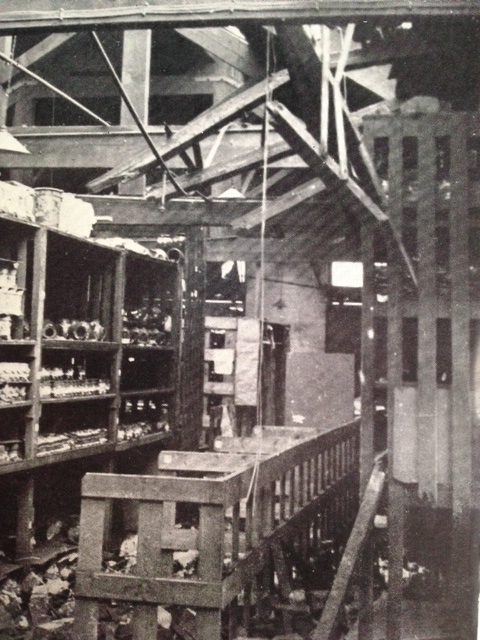
Damage to the Burslem warehouse October 1940
The war came early to the Burslem factory, when in October 1940 a three-storey warehouse housing finished goods and also the Art Director’s studios were bombed. Here you can see a couple of pictures of the debris it left behind. Try as I might the only things I can pin point are a Limited Edition Jug and what is probably some Flambé ware.
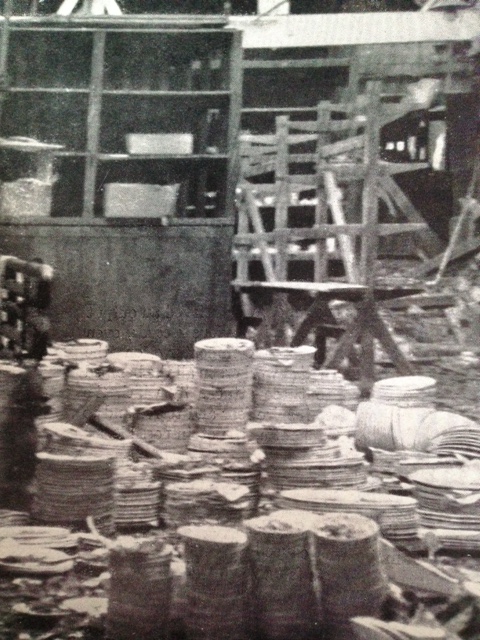
A further view of the damage cause to the warehouse at Burslem in 1940
At Lambeth too, the factory sustained damage as did many of their employees’ homes. In May 1941 the Lambeth showrooms took a direct hit and were destroyed but fortunately there was no loss of life at that point. In typical Doulton form for the company at this time, financial assistance was provided to employees suffering from war damage to their homes.
Whilst the above is merely a snap-shot of events during the war-years, it allows us to share these unique pictures from the time.
Reg Brown was destined to play a pivotal role in the field of Doulton’s figure production. Born in 1909, he died at the early age of 53. He spent most of his life living locally to the Burslem factory in Wolstanton. Doulton typically became something of a family affair for the Browns, with his daughter-in-law working in the Character Jug department and his youngest son in the Doulton laboratory.
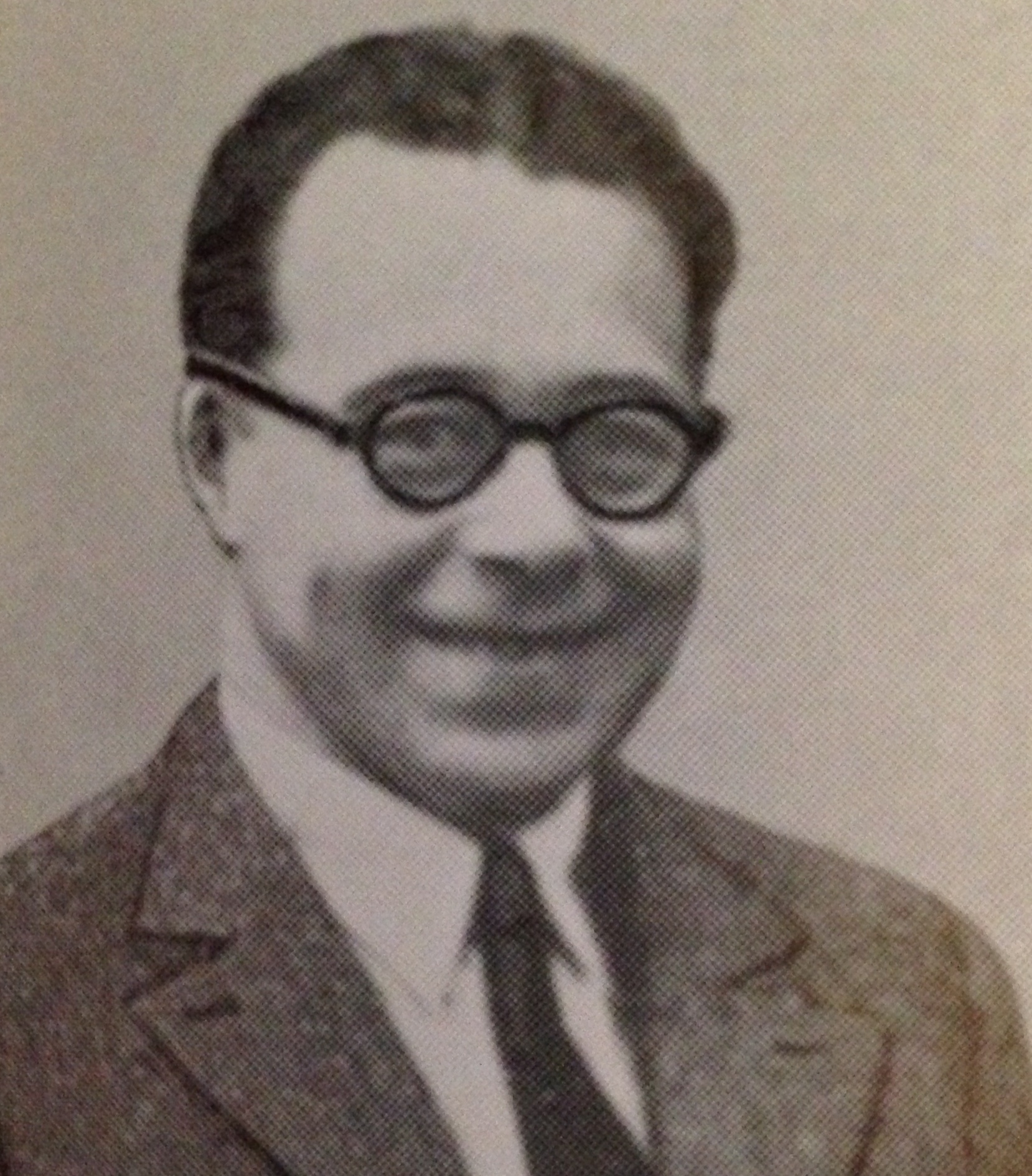
Reg Brown ca. 1950’s Head of Doulton’s on-glaze Figure Painting Department
Reg was originally a pupil of Herbert Betteley at Doultons and of the same school as Tom Parton, Charles Hart , Bernard Green, Harry Stevenson, Roland Holdcroft, Jack Pierpoint and others. He studied at the Burslem College of Art and from an early stage showed versatitily in painting landscapes and castles amongst many other subjects with prowess. However, he was destined to join Harry Allen, Norman Woodings, Charles Nixon and a handful of other men who formed the nucleus of the original figure painting department.
A founder of the Doulton Art Society, a member of the Doulton Sports Club and the Doulton choir, Reg would eventually become head of the On-glaze figure painting department, a position he would hold until his untimely death.
Collectors I know specifically look for Reg’s figures as they have exquisite faces and are superbly painted. I am fortunate to posess a few colourways also painted by Reg from the 1940’s, no doubt from his time as the head of department and the colourings are just wonderful in real life. One of my favourite figures painted by him is this colourway of Christmas Morn from 1942.
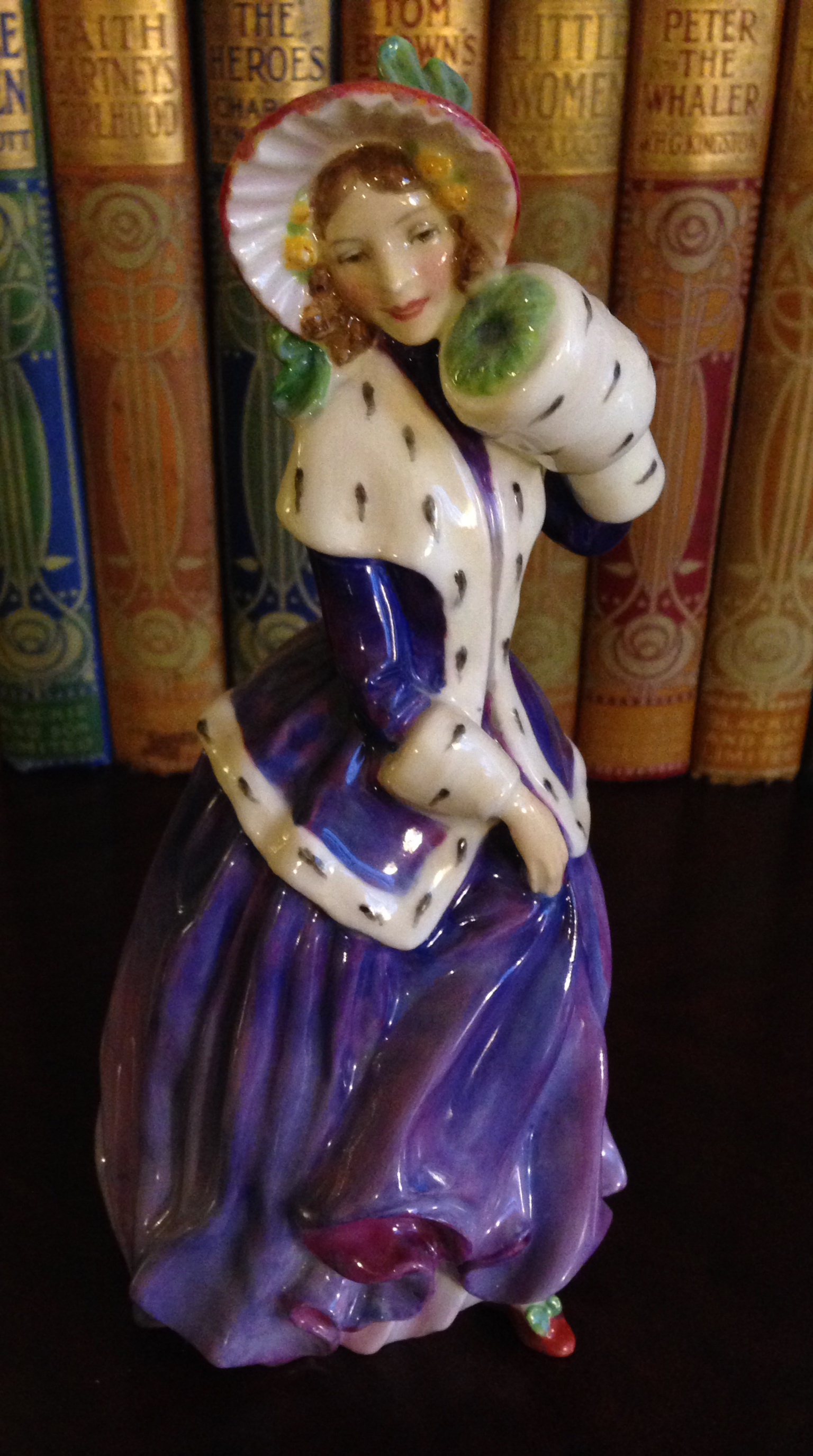
Once again, why not see how many of your pieces are painted by Reg – and what a great theme for collecting figures!
Simply search Facebook for the ‘Doulton Collectors Club’ and ask to join, then you can ask questions a view a variety of material from around the world!!!
What are you waiting for?
Child studies have always been popular with Royal Doulton collectors, and from the launch of the HN range child studies have played a key role in the range. We all know of course the famous story behind Darling HN1 modeled by Charles Vyse, but collectors are sometimes surprised to see that Leslie Harradine, perhaps the most collected of all Royal Doulton modellers, also created many charming portraits of children. With six children of his own he certainly had much in real life to base his models on. Unfortunately we do not know if any of the figures he supplied to Royal Doulton were based on any of his own children, but we do know a few of the sources he used.
If you look at my book ‘Reflections’ you will see a section dedicated to Molly Benatar and Harradine based his Miss Muffet HN1937 clearly on one of Benatar’s designs for Raphael Tuck, the greetings card specialist. Even the coloring of this figure is copied from the original.
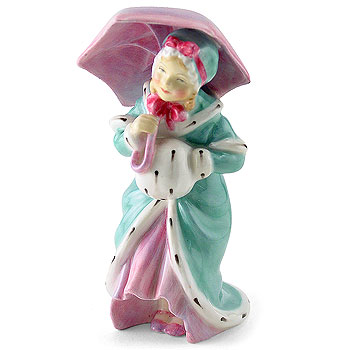
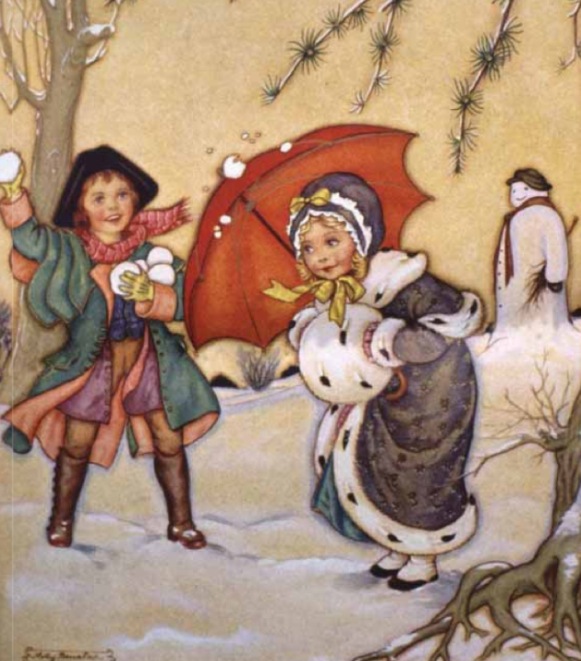
Miss Muffet HN1937 and Molly Benatar’s ‘When hearts are young’ illustration
A recent discovery of mine is also that Nana HN1766 is based on another of Benatar’s pictures. The skirt, the hair and the hat worn identify Nana.
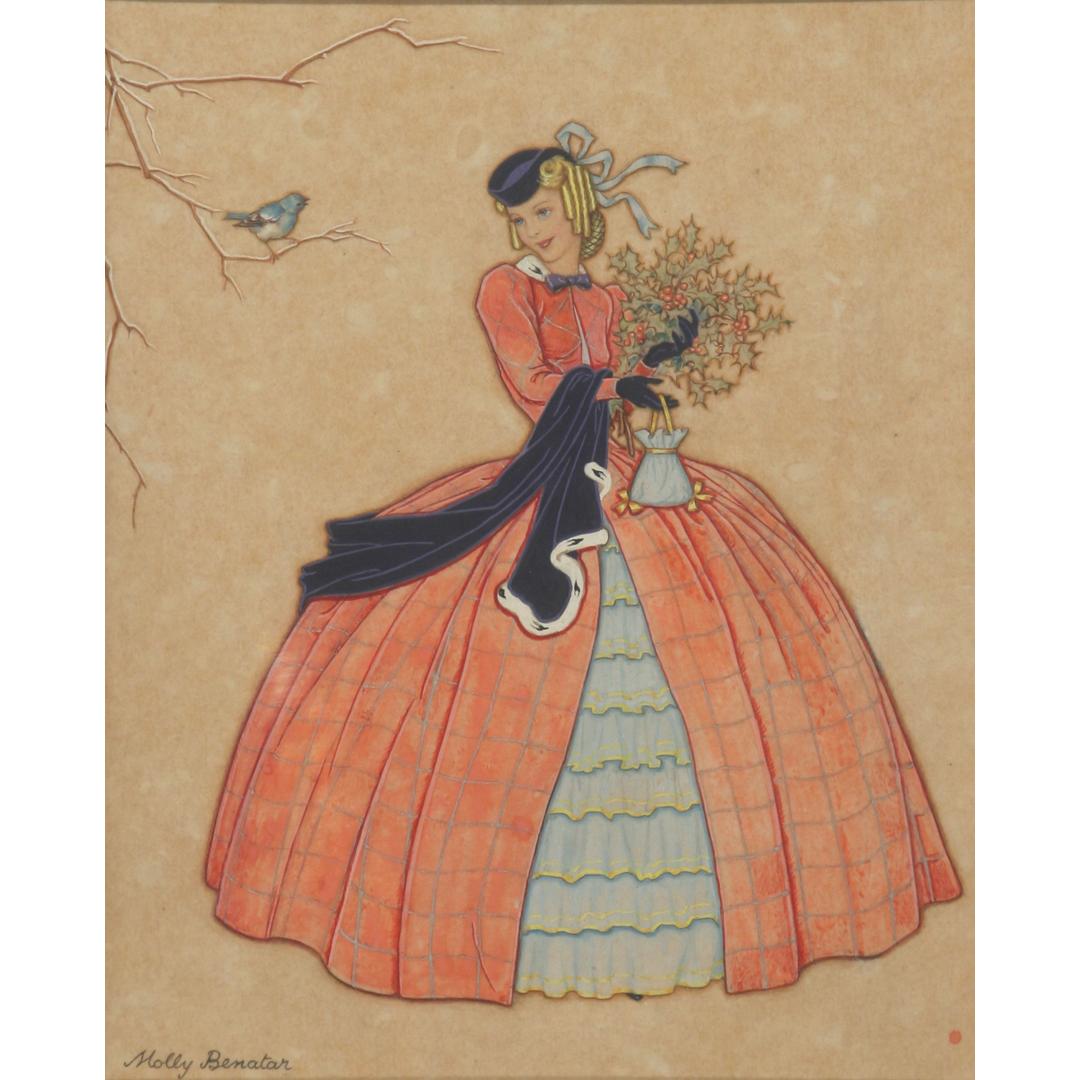
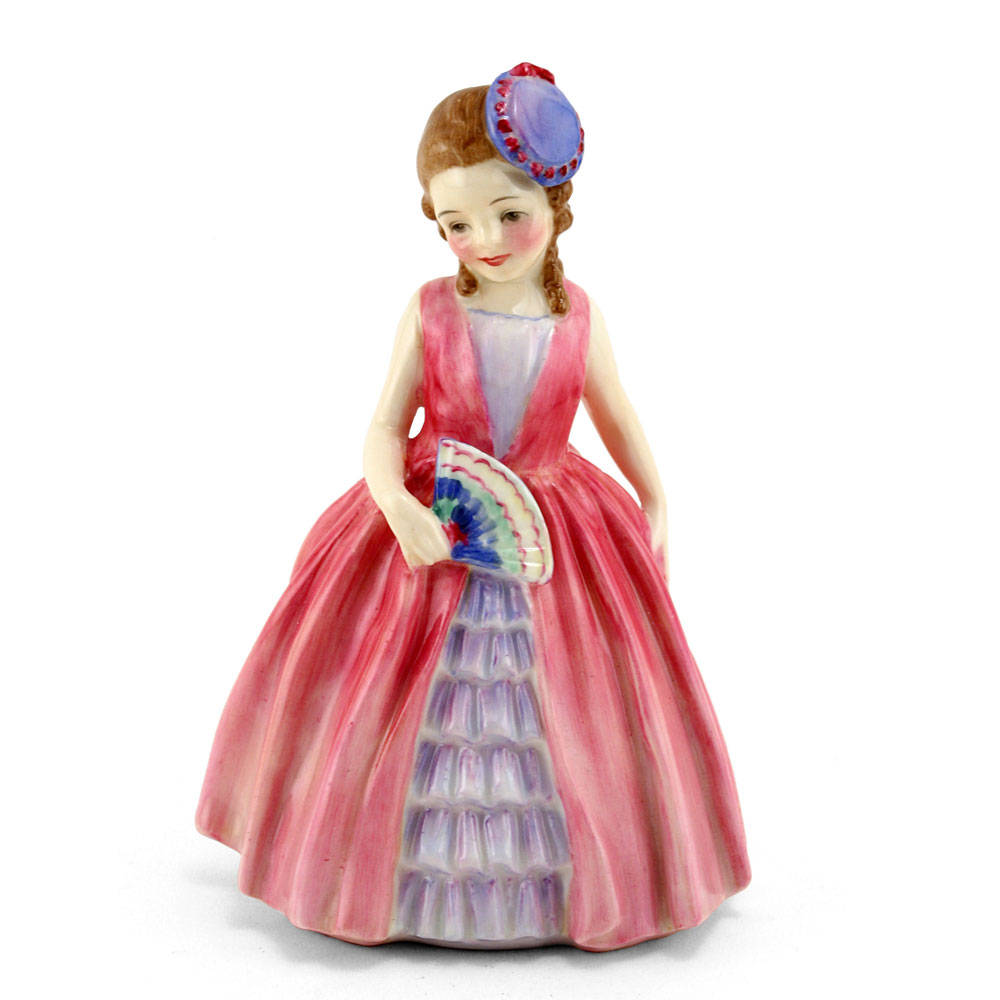
Molly Benatar illustration and Nana HN1766
Another of Harradine’s most popular child studies is Sweeting and she , dressed in her party frock, was inspired by an advert for the once eminent London department store Marshall and Snellgrove.
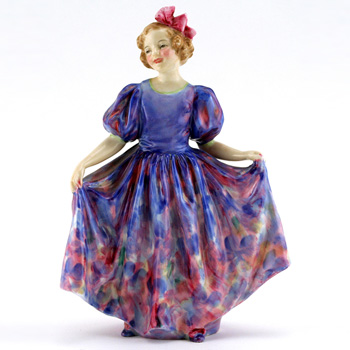
Sweeting HN1938
Other child figures by Harradine simply reflect childhood at its most innocent, consider Pyjamas HN1942 or To bed HN1805, either of whom could have been anyone of us in our early years. Harradine was able to capture a certain charm in his child studies, just as his did so perfectly with the bevy of ladies in so many varying guises, that he now is famed for.
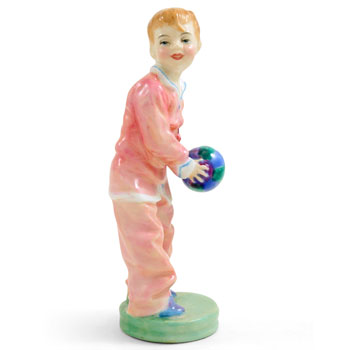
Pyjamas HN1942
One particularly popular child figure is Marie HN1417 introduced in 1930. A purple version of this figure was made up until 1988. Originally made as a pair to Rose HN1368, they can both be found in complimentary as well as contrasting colorways, and more unusually you can find them mounted on bookends and other objects. The enduring popularity of Rose meant that a new colorway HN2123 was introduced in 1983.
As with most Harradine figures, his child studies were also issued in several colourings. Particular favourites of mine are Lily HN1789, Ruby HN1724 and Diana HN1716. All three young girls display perfectly with their taller counterparts. Harradine understood precisely Royal Doulton’s requirements and when a popular theme was established he sought to develop it further. The world-famous Royal Doulton street sellers is one such case where a child study, namely Linda HN2106 was introduced to expand that series.
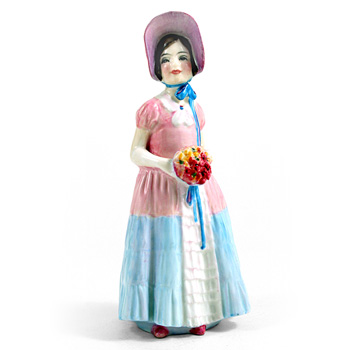
Diana HN1716
A final figure I would like to bring to your attention is The Rocking Horse HN2072. This particular figure I am sure you will agree is simply charming. The only reason I can summise for its short production (1951-53) is that the figure was too costly to produce. The inspiration for the piece is no doubt the film The Rocking Horse Winner from 1949, where the young hero discovers he can predict race winners by rocking his horse.
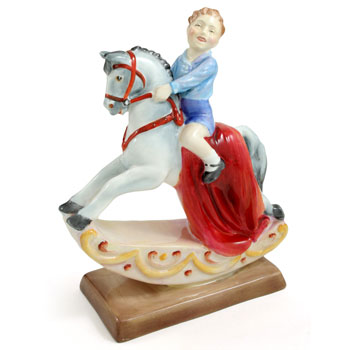
The Rocking Horse HN2072
It is indeed an arduous task to try and re-assemble something long after the event, but for many years I have been trying to find out as much as possible about the early figure painting department at Burslem. The changes these early artists must have witnessed and the speed at which they occurred must have been mind blowing.
One artist whose monogram appears time and again on the bases of figures from the 1920-40’s is Eric Webster, born in 1896. Eric retired from Doultons in December 1962 and the last remaining link to what was known as the ‘Noke’ school of artists was lost. Originally engaged by John Slater, the first Art Director at Burslem, Eric served most of his years under the guidance of Charles J. Noke who succeeded John Slater as Art Director.
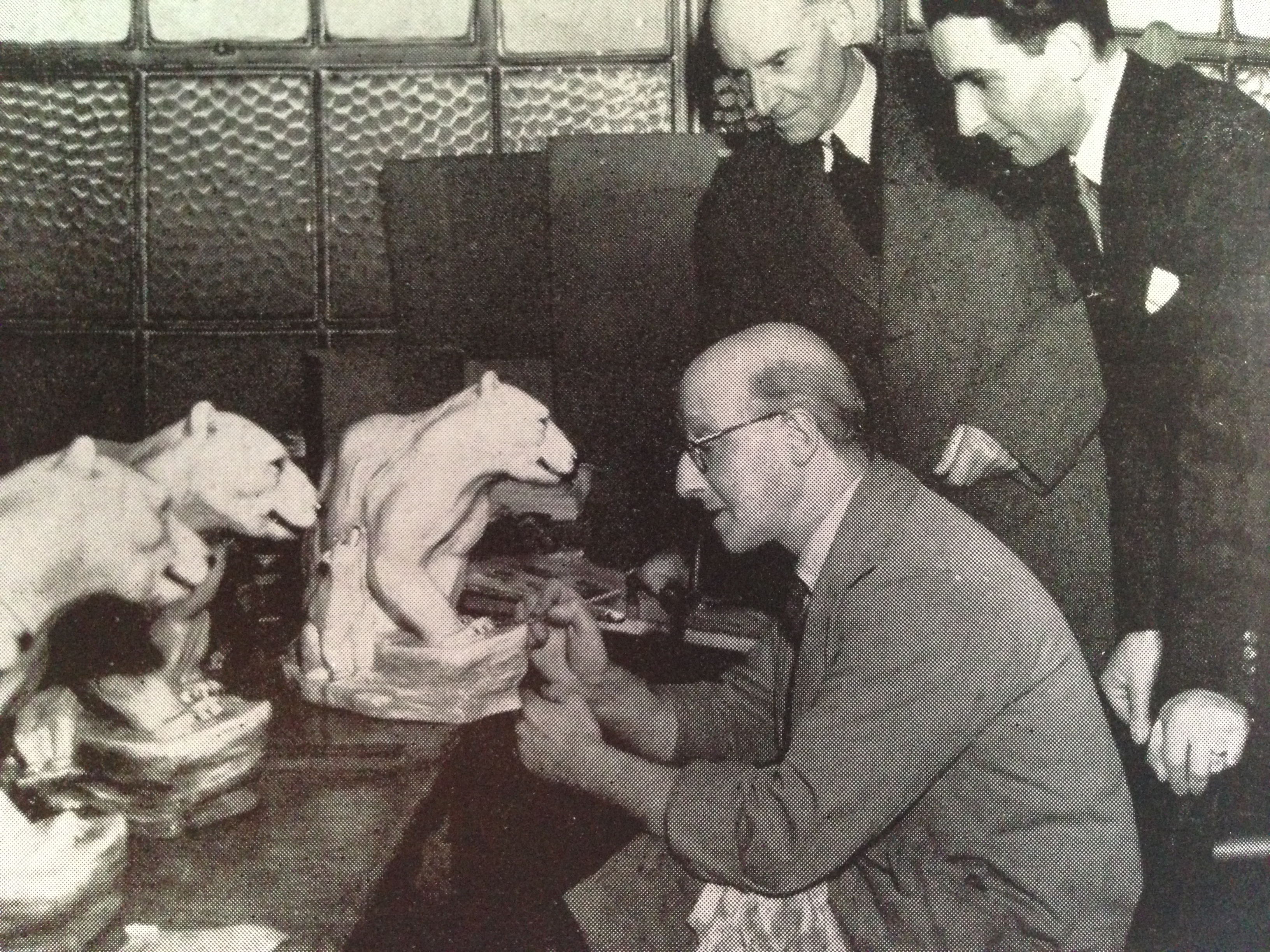
Eric at work 14th October 1953
Eric was born and bred in the potteries and attended the Tunstall School of Art. When he arrived at Doultons he was engaged with painting plates and vases, and although a versatile artist – landscapes were a preferred theme. As the Doulton archive itself describes, around the time of the First World War, C. J. Noke began introducing ‘small pieces of sculpture in the shape of Victorian type figures and small animal models.’ This was of course the launch of the now famous HN collection and Eric together with Harry and Charles Nixon were the first three to be engaged in the decoration of the figures and animals. Eric being principally involved in the latter’s decoration. Incidentally the HN numbers we all know originated from the initials for Harry Nixon, just mentioned. However, Eric must have been prolific painter as his monogram is readily found on figures too from the 1930’s.
There were many high points to his long career with Doulton. Notably the painting of the first Championship Dog model ‘Lucky Star of Ware’ and later the model of the present Queen’s horse Monaveen, that was produced for her visit to the Doulton premises in Burslem, when still a princess in 1949 (see the video link already posted for actual footage of this famous visit). Eric reportedly visited the stables to take sketches in colour so as to ensure accuracy in the actual painting.
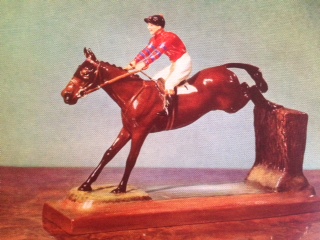
A publicity shot of Monaveen, not available to purchase
Animal painting was clearly a forté of his and it was no surprise in ca. 1925 that he was entrusted to take charge of a newly created department responsible for animal painting.
In his later career, Eric was responsible for painting prestige pieces, which were made to order. Here he is seen collecting a cheque and gifts from his friends at Doulton, including a naturalistic fox painted by himself!
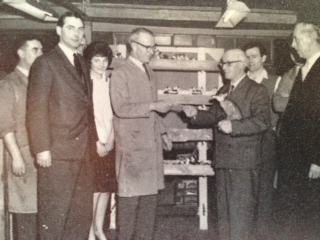
Eric at his retirement presentation, holding the large fox model
If you look at the bases of your figures and early animals check for an ‘EW’ or ‘EAW’ and that is our man!
One final area I would like to touch on is the Doulton Lambeth factory. Whilst worldwide acclaim had been found since Victorian times with the works of Tinworth and also Hannah Barlow , their particular styles belonged to a bygone age and taste by the time the 1920’s had dawned.
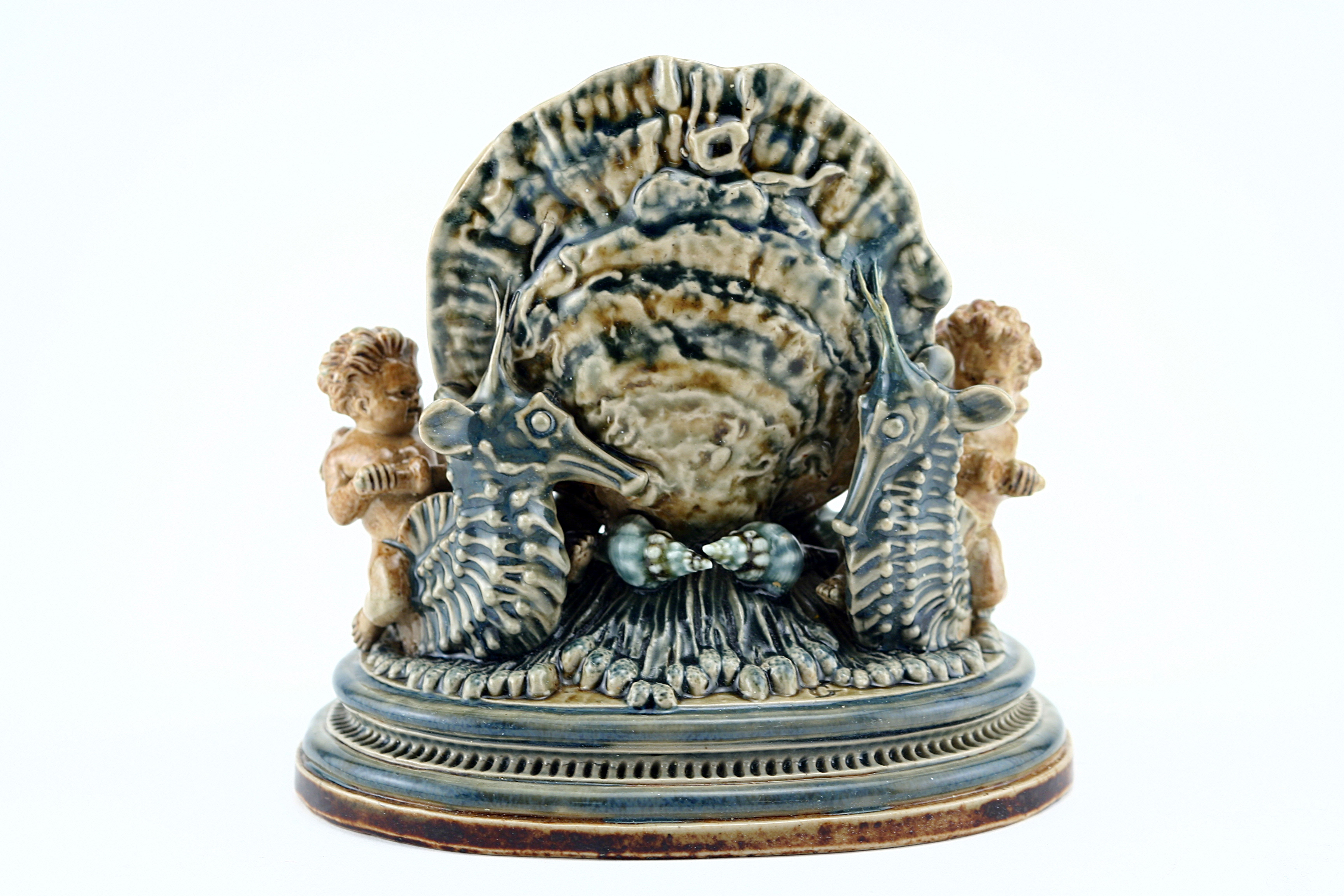
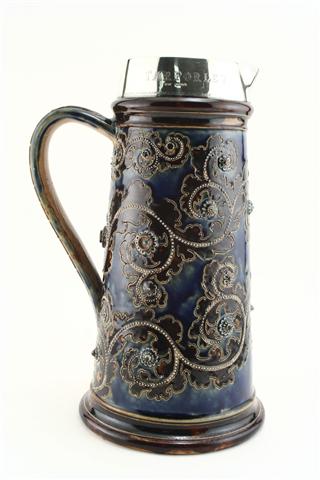
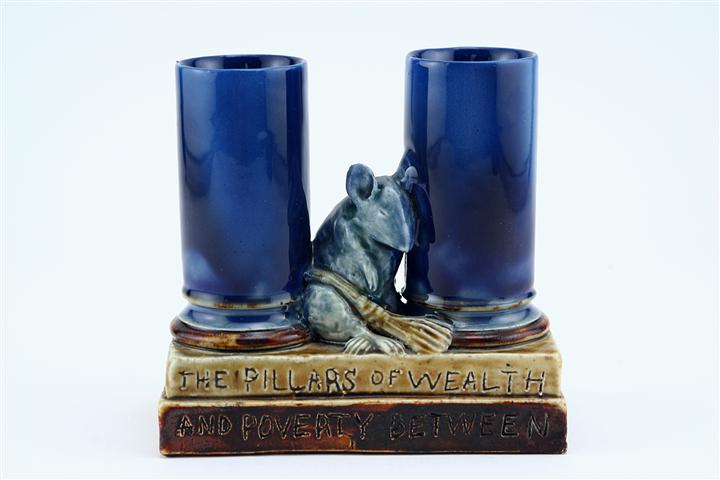
Examples of Tinworths skill and artistry
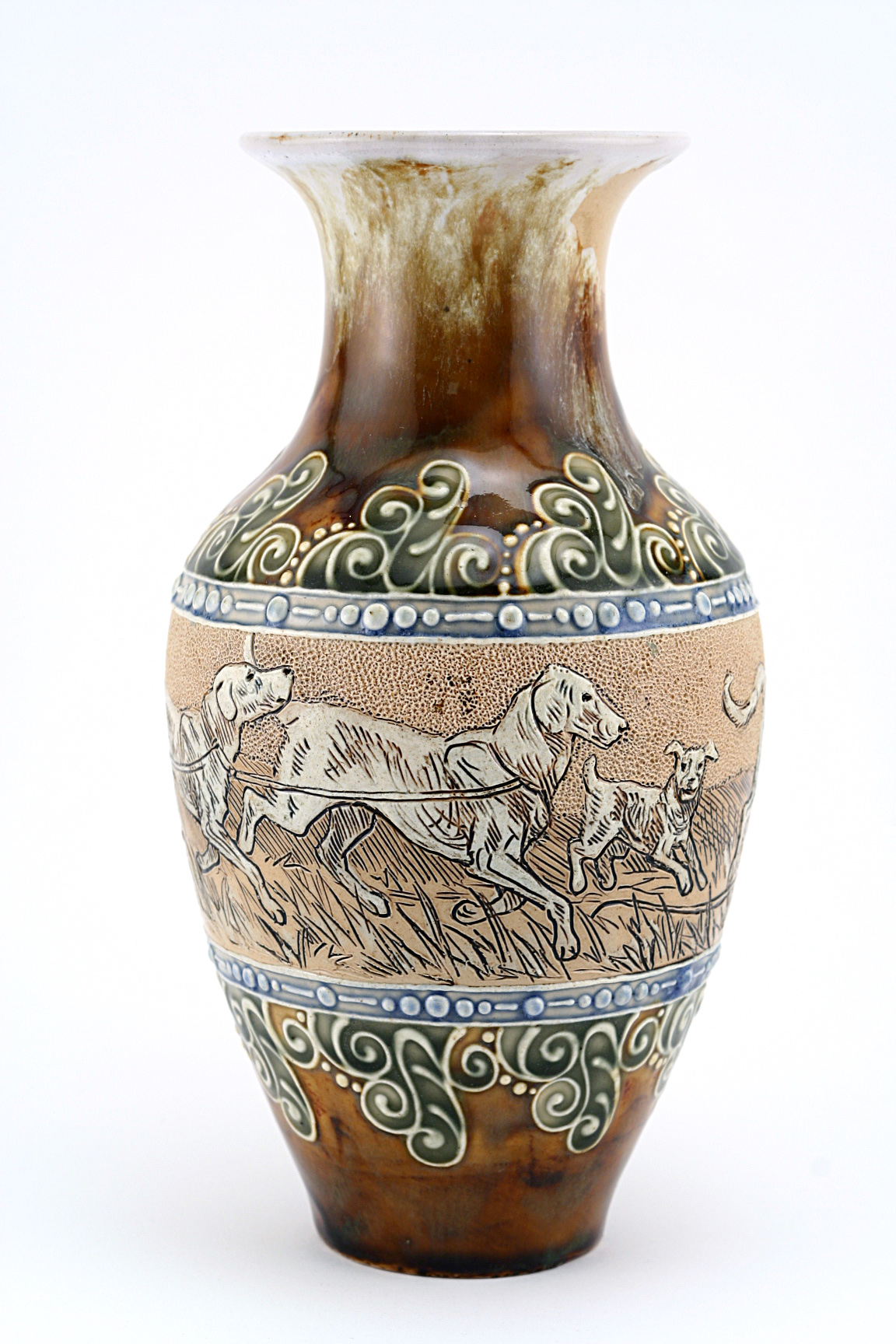
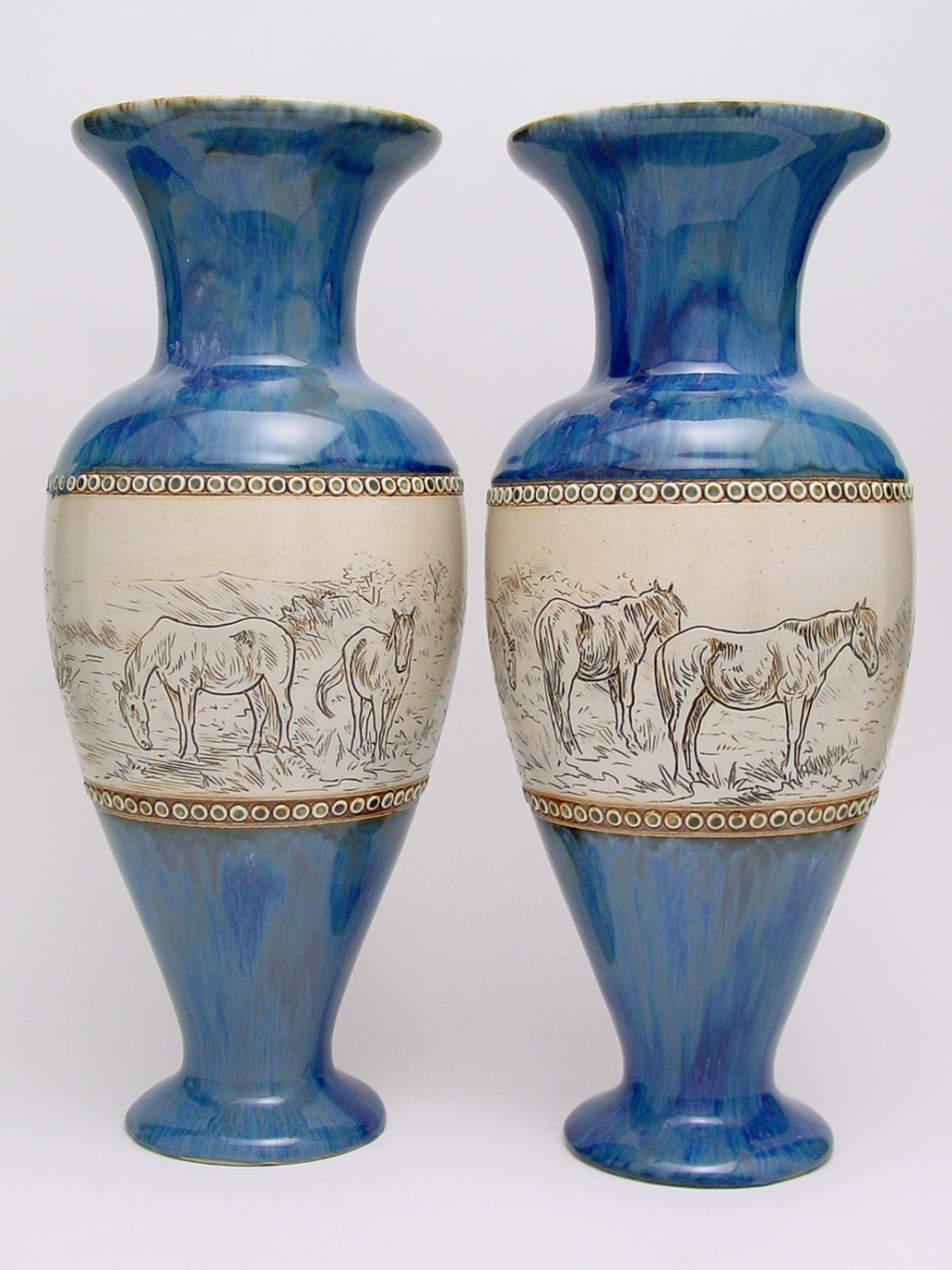
Examples of Hannah Barlow’s high Victorian style
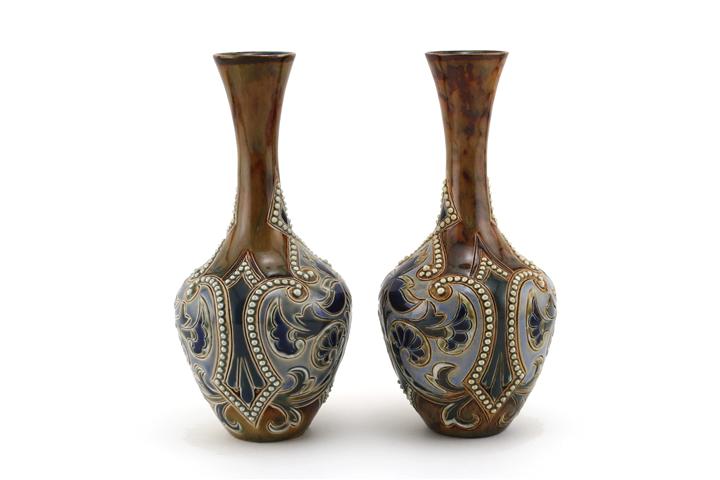
Without doubt the skill of these two great Lambeth artists cannot be denied, but as Leslie Harradine himself once commented, he preferred the amusing Tinworth mice to the dreary biblical plaques so preferred by Tinworth. The styles of these two artists hardly changed over the course of their careers, unlike many others whose designs remained fresh, even long after their productions. Consider the work of Mark Marshall here.
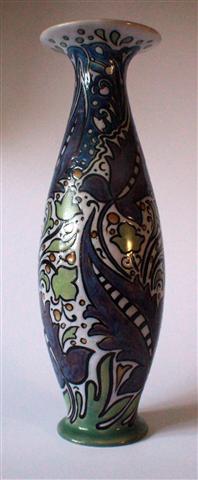
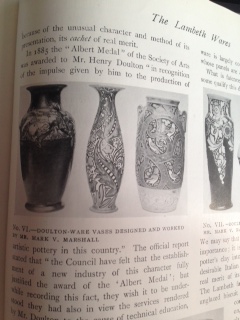
16″ Marshall vase together with a press review of the centenary celebrations of the Lambeth factory in 1915 at which the same vase was displayed
In stark contrast to the grotesques he favoured either side of the turn of the 20th Century, here you can see an example of his work which even today seem remarkably up to date.
Similarly we have Eliza or Elise Simmance. She is unarguably one of the most versatile of all the Lambeth artists. Consider here a selection of her works from the beginning to the end of her career.
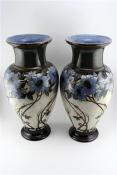
Early and later example of Simmance’s versatile style
Below is an excerpt from a Doulton brochure from the deco period. As you can see there was an emphasis on colour and shape. More interestingly is the fact that Doulton chose to advertise just pieces which could be reproduced rather than artist pieces – it was after all in business to sell, sell, sell. These production pieces, or ‘Late Editions’ as they have become known were of course designed by Lambeth’s major artists including Mark Marshall, Francis Pope, Leslie Harradine and Margaret Thompson amongst others.
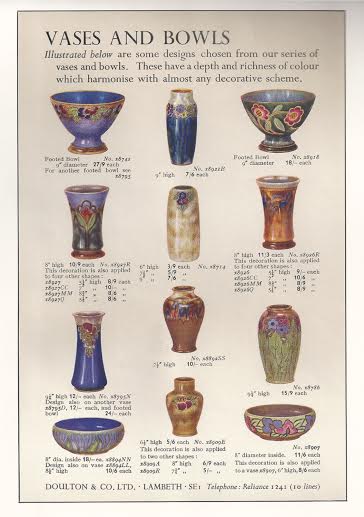
Catalogue page ca. 1934
I am a particular fan of Margaret Thompson’s work, whether it be her Late Edition pieces, her wonderful faience work on vases and tiles or even her artist pieces in Stoneware.
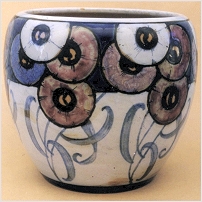
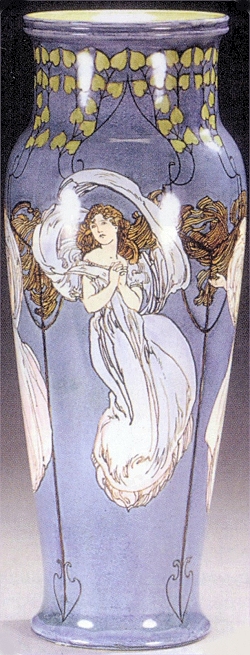
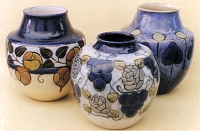
A stylish Margaret Thompson jardinière, an example of her faience work and three late edition pieces ca. 1920
And there we draw to a close with out restrospective into Doulton wares from the 1920’s and 1930’s. I hope that you have learned something new and also seen that in order to stay ahead of their rivals Doulton was ready to welcome the decadent 20’s, and change production accordingly.
I would like to thank Seaway China for the use of their picture library together with my own Ventafile, and of course if you have any questions relating to our talk or indeed anything else Doulton please just ask !
The introduction of Doulton’s ‘Character Jugs’
Together with the re-establishment of Staffordshire figure production, Noke senior also strived to re-introduce the long neglected production of Staffordshire Toby Jugs. Thus in the swinging 20’s Noke’s toby jugs of Charlie Chaplin and George Robey were introduced.

The very rare Charlie Chaplin toby jug
These are very rare today, and a further jug of a Huntsman from 1919 were the sole productions, until Doulton introduced their own version of the traditional Toby Jug, more commonly known to us as Character Jugs. Unlike the traditional Toby Jug, Doulton’s Character Jugs focussed on only the head of their character. Thus in 1934 the first Jugs, John Barleycorn and Old Charley, were introduced.
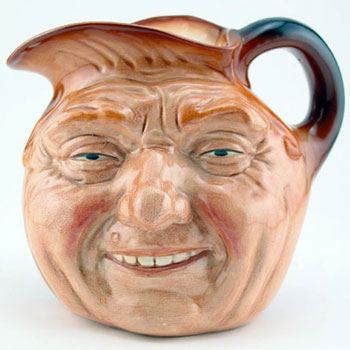
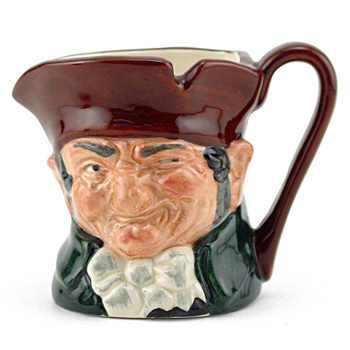
The ever popular John Barleycorn and Old Charley jugs

Our good friend Lucy at the Wedgwood Museum looking through the original CN design books.
They were swiftly followed by many other instantly recognisable faces including Sairey Gamp, Dick Turpin and Parson Brown. The first reference to character jugs is recorded in Doulton’s factory design books in 1935. Before the end of 1934 another modeller was coming to the fore of character jug design, he was Harry Fenton, who together with Charles Noke, jointly and later separately were responsible for all the jugs introduced until 1948. The range was quickly expanded to include small size jugs in 1935, and then a medium size in 1938 of 6 dickens jugs, which proved unpopular and were withdrawn in 1948.
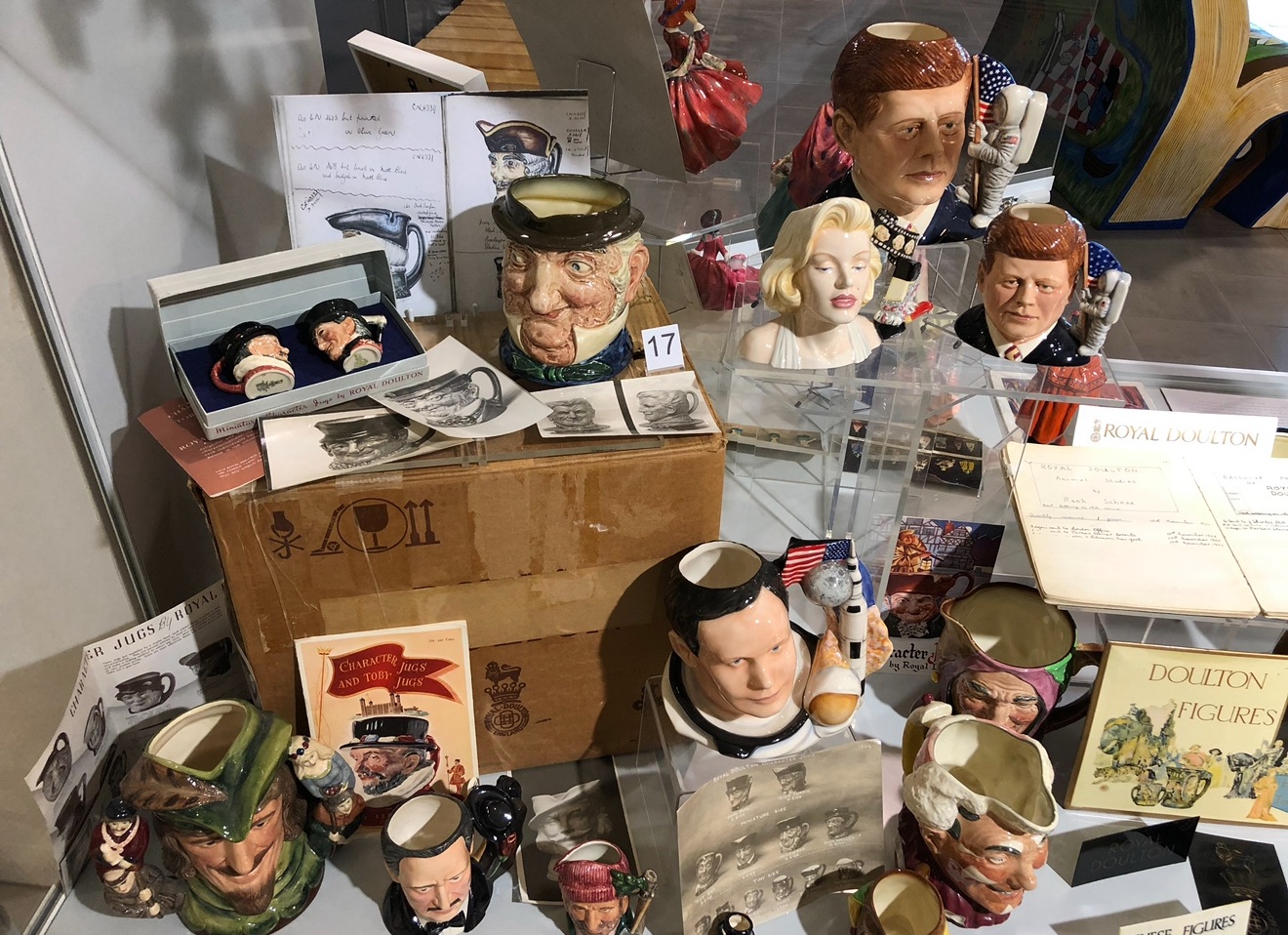
A selection of rarities from one of the Club exhibitions.
Since that time we have grown used to referring to large, small, miniature and tiny jugs. A more recent attempt at medium jugs has been tried but that is for a future article! The late 1930’s also saw the introduction of the first Character Jug derivatives including tobacco jars, musical jugs and even tea pots.
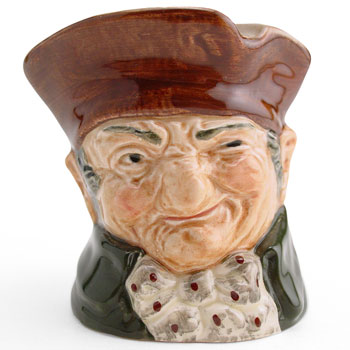
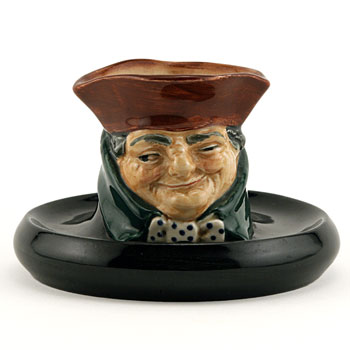
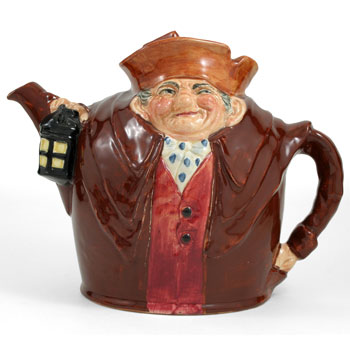
Three wonderful Old Charley derivatives
The beginning of WWII brought the inevitable slowing down of production and the introductions of new jugs just as it did with the figure department, although prototypes were being made such as the infamous Maori and the white matt Winston Churchill loving cup of 1941, produced specially for the ‘American and Empire markets’.
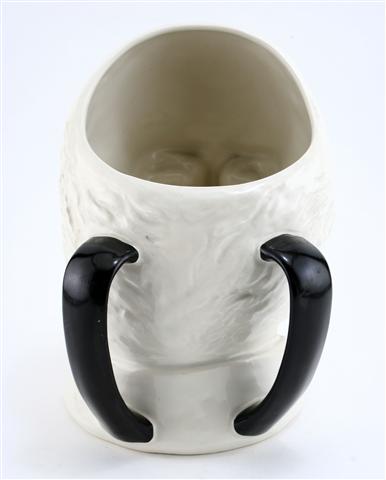


Three views of the famous Winston Chruchill jug
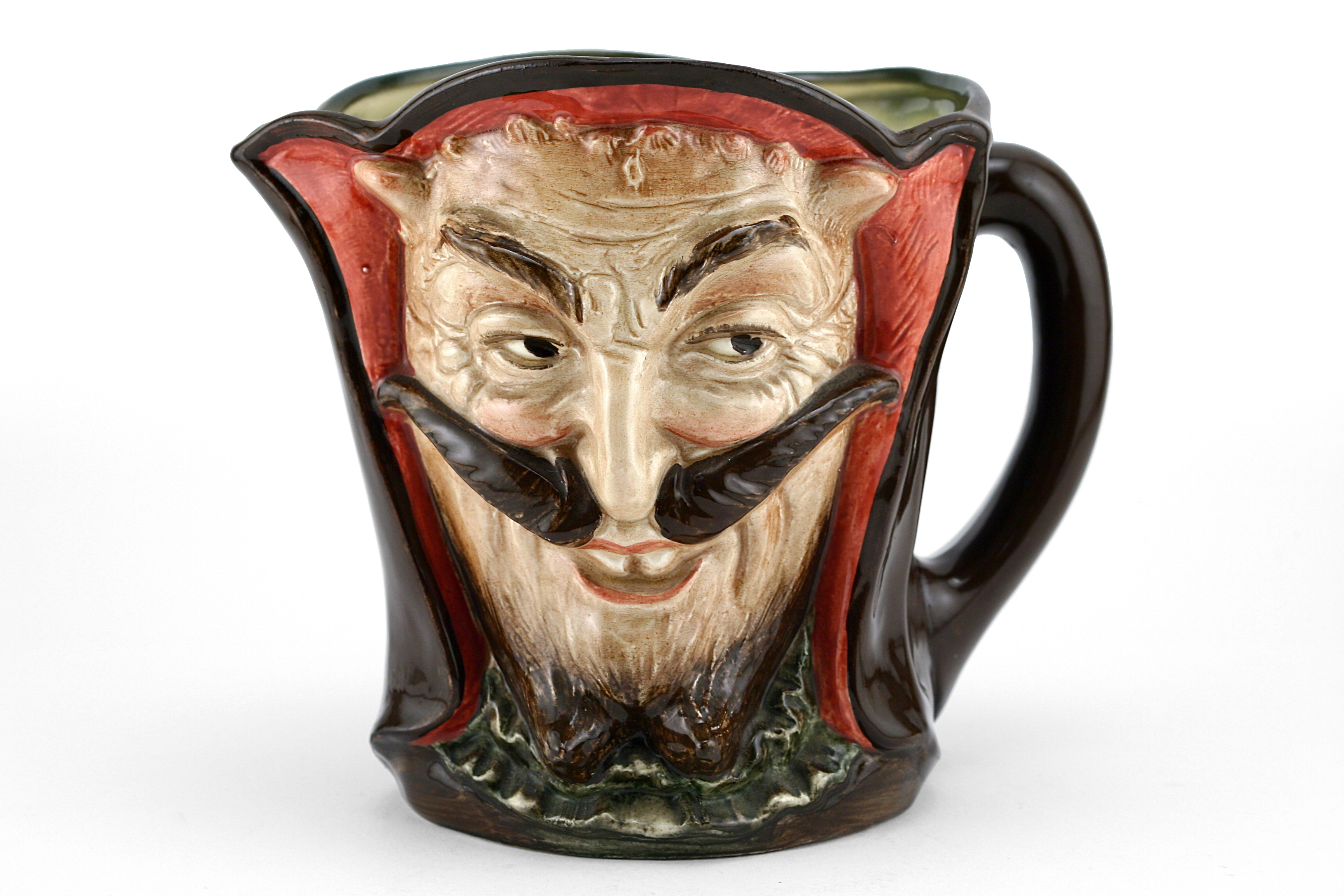
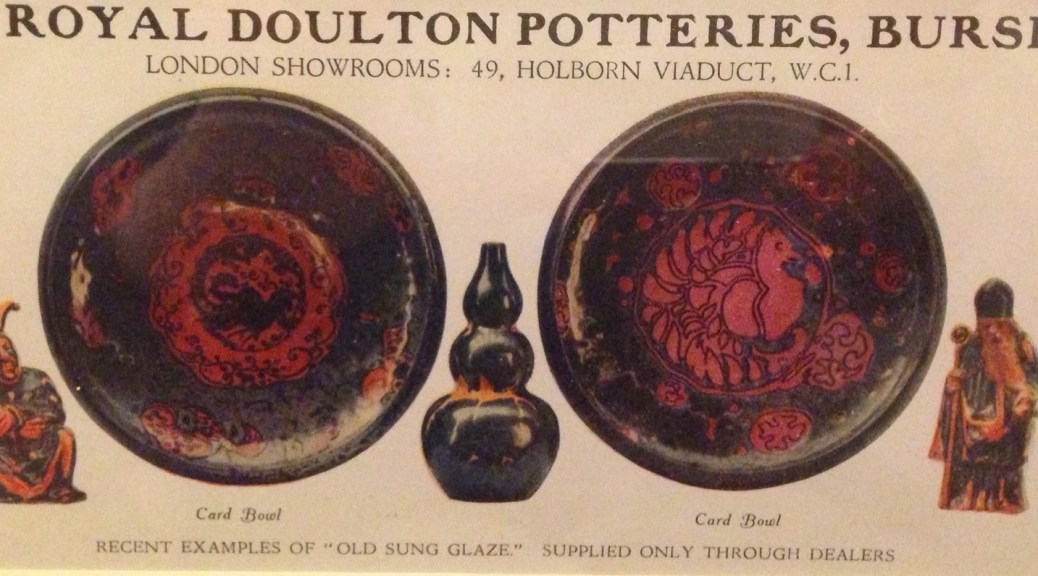
With many hundreds of Jugs having now been introduced, amongst them variations, prototypes and others with often subtle variations, this area of collecting Doulton often becomes intense with a few die hard collectors willing to part with tens of thousands of dollars to secure that one piece. This fever is fuelled by specialist books on the subject as well as many clubs and societies the world over. Here you can see a selection of particular raritites and favourites…..


 doultoncollectorsclub