All posts by doultonchristopher1

Royal Doulton’s early horse models.

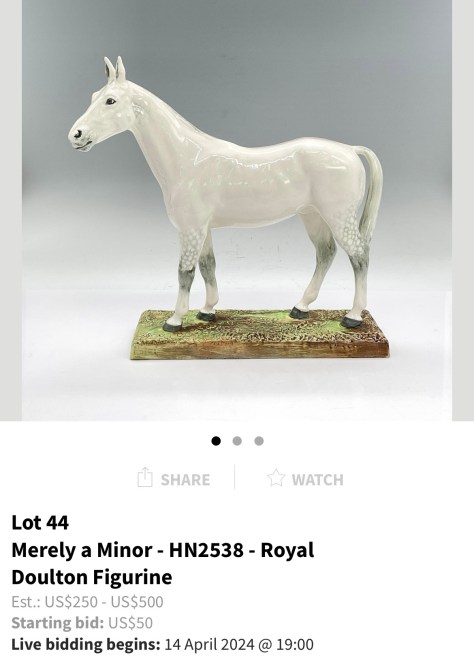
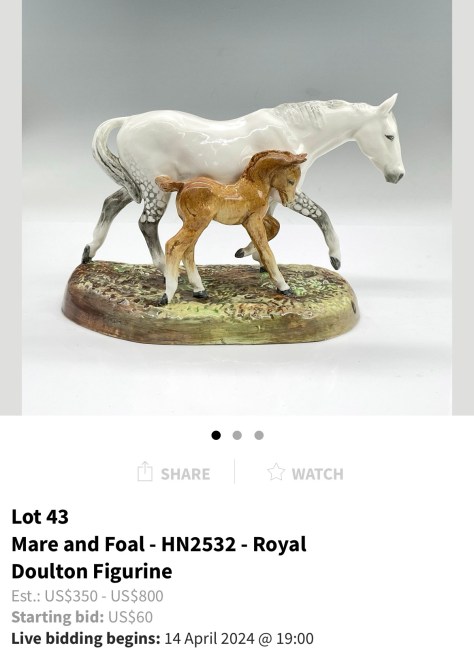
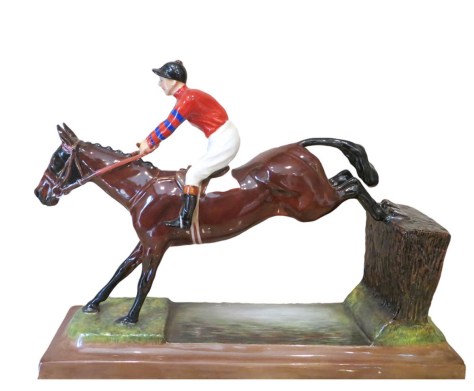
Doulton’s first horse models for the HN collection all featured riders, however, their first solo horse models introduced in 1940, were the work of William Chance, commissioned to launch a new range by Doulton.

Chance was an established sculptor having exhibited widely including at the Royal Academy. He modelled from real life and his Doulton models proved popular and many were available in large, medium and small sizes, with the last remaining models being deleted in 1966.

The varying sizes of horses available from this first series make it an interesting field to collect and together they make a great display.


Chance also created the special piece Monaveen for our present Queen, when she visited the Doulton factory in 1949 as the then Princess Elizabeth. Monaveen was a steeplechaser owned jointly by the Queen and the late Queen Mother and not produced by Doulton for sale. The piece was expertly painted by Eric Webster, whose long career at Doulton’s we looked at some time ago.

Monaveen (courtesy of WMODA)

Horses continue to be produced by Doulton into recent times with new prestige pieces from Peggy Davies’ The Palio to the more recent Alexander the Great HN4431 as well as those produced in the early 1990’s as part of the DA range of animals.

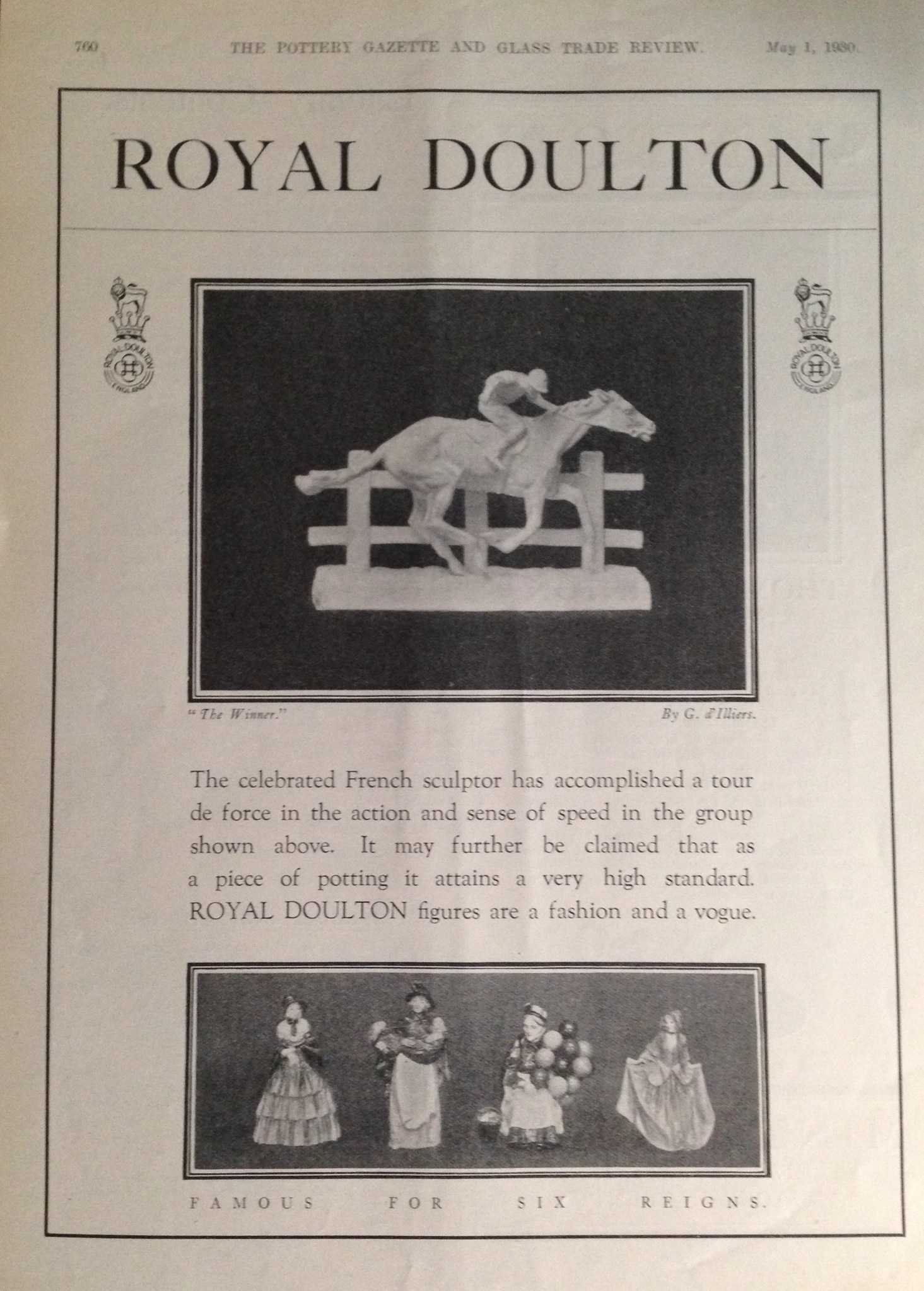
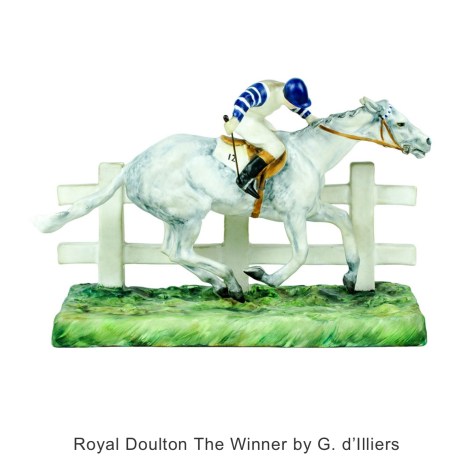
To finish I thought you might all like to see this advert I found many years ago, stating that the famous French sculptor Gaston d’Illiers was responsible for the very rare study The Winner HN1407. This skilfully created model shows the horse in full gallop and straining every muscle. It is reputedly based on the horse Royal Doulton, owned by the Rousten Brothers of Auckland, New Zealand.

IMG_0410.JPG
The Winner advert from 1930.

Courtesy of WMODA.

Australia’s John Shorter – Doulton’s Australian agent

IMG_0372.JPG
I am sure many of you will be aware of the name Shorter, no matter where in the world you live, especially if you have an interest in all things Doulton. John was Doulton’s original Australian representative in 1889.
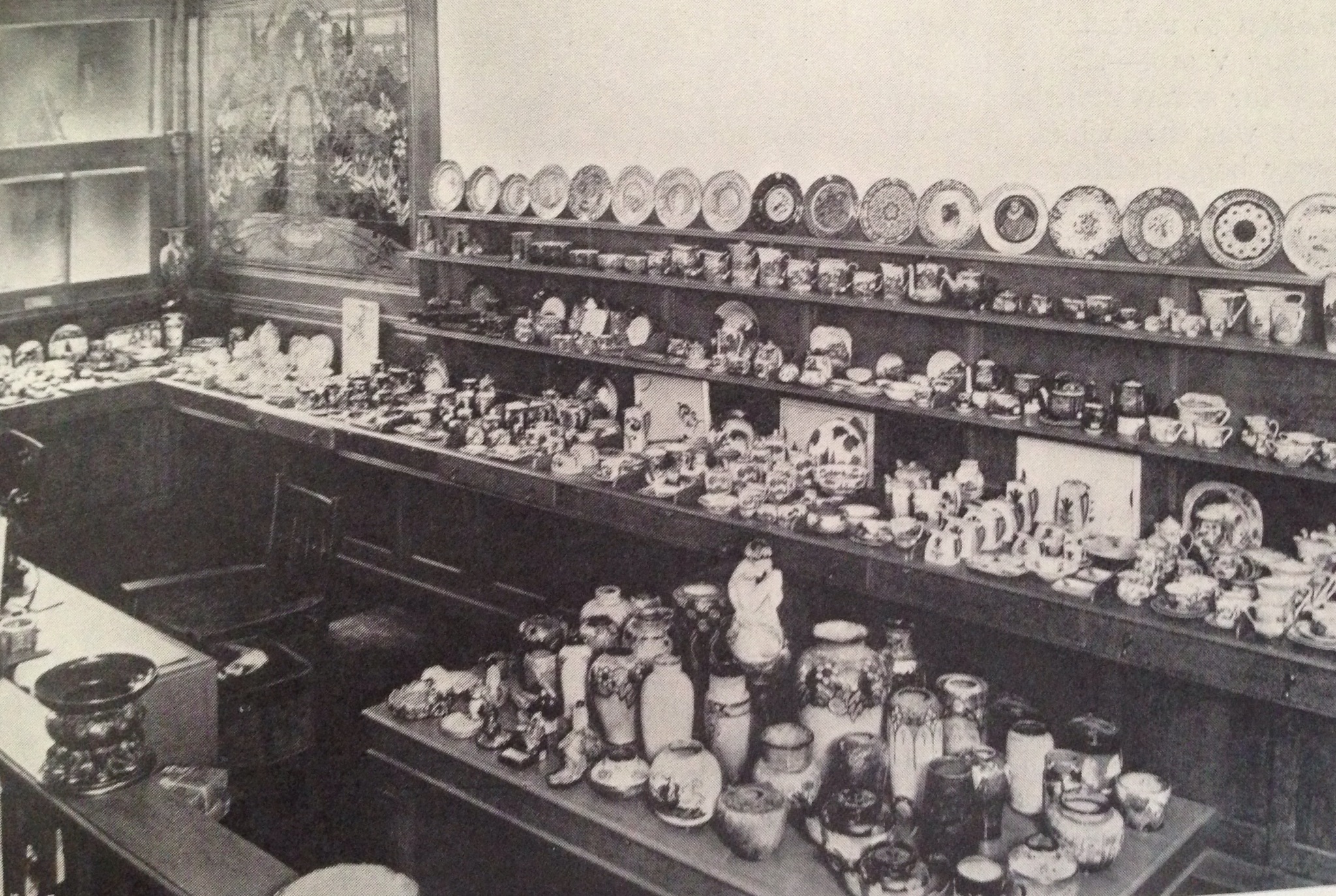
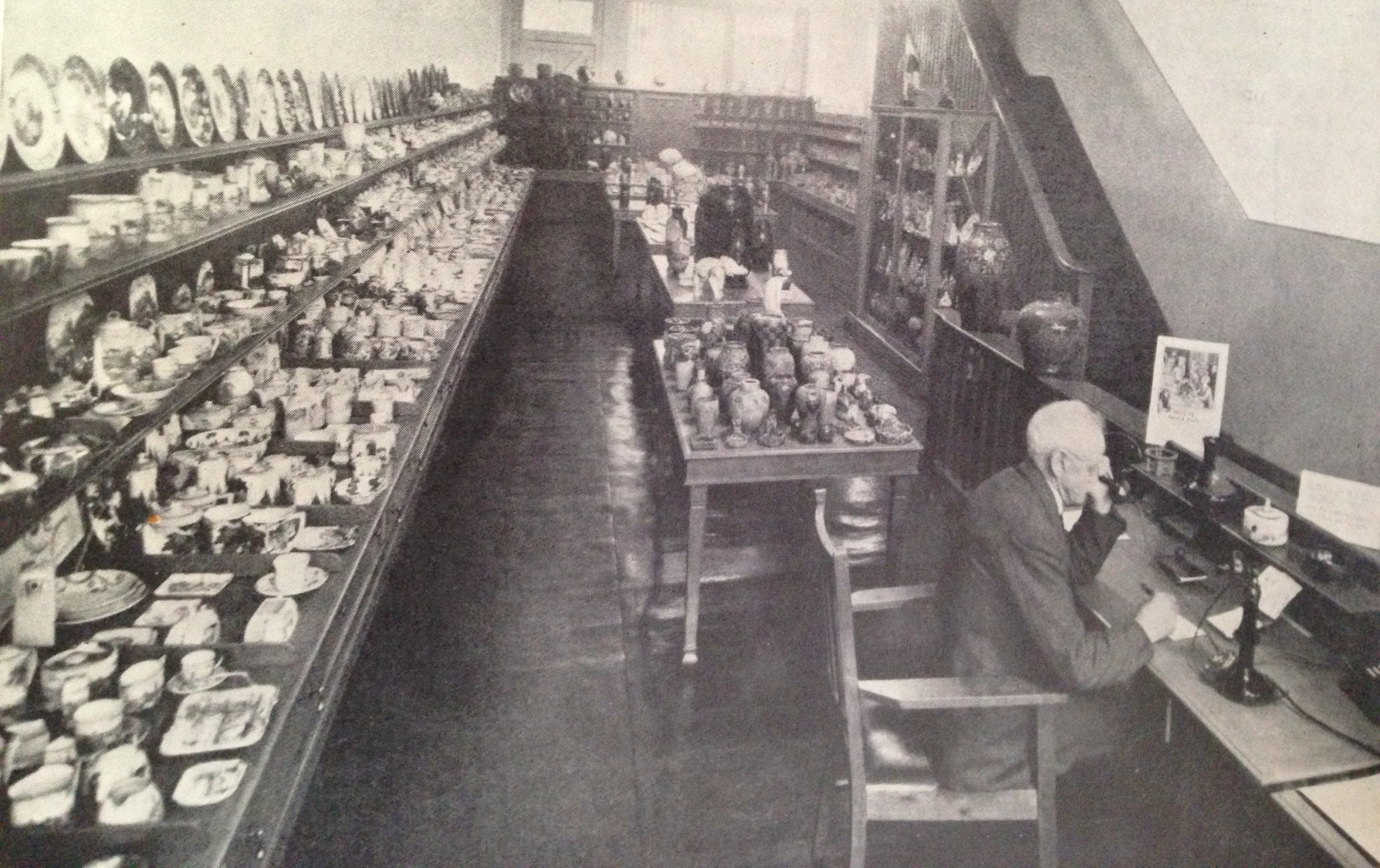
I came across an interesting interview with him from 1934 some time ago accompanied by these wonderful shots of his showroom in Clarence St. Sydney which also had a Doulton frontage, a gift from Mr Henry Lewis Doulton. Inside too, there were two magnificent tile panels by William Rowe ‘The Earth’ and ‘The Sea’. One of which you can see in these pictures.
Anyway, you can see for yourselves the wonderful array of Doulton wares available through the Shorters!

IMG_0373.JPG
As well as selling Doulton John Shorter was also a collector and was lucky enough to be offered a 1000 piece collection built up by Doulton’s first Art Director at Burslem, John Slater, after his death. Some of this collection he sold to John Bates of Christchurch and the remainder, was gifted to what is now the Powerhouse Museum in Sydney.

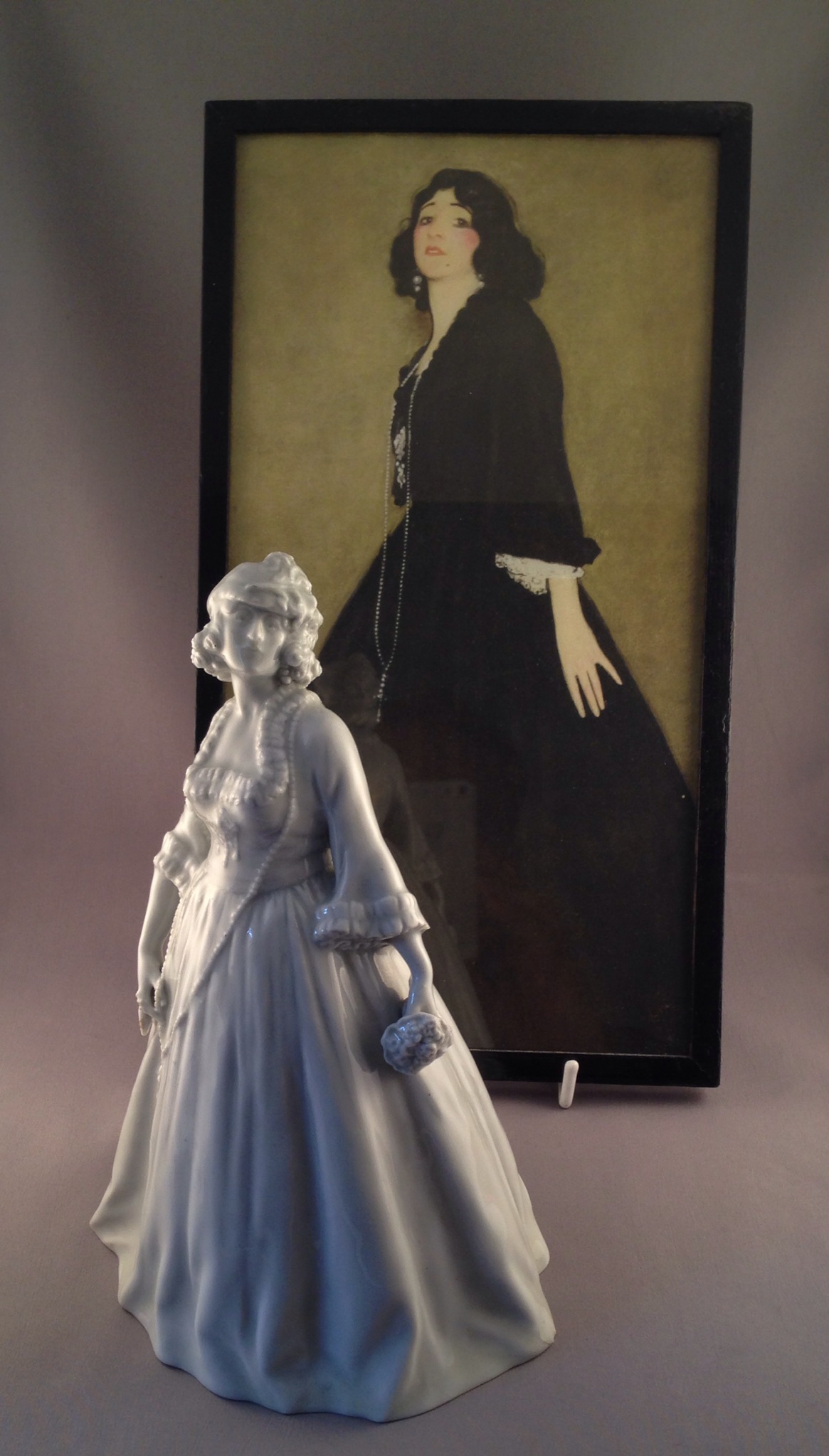
Royal Doulton’s tribute to the American actress Doris Keane.

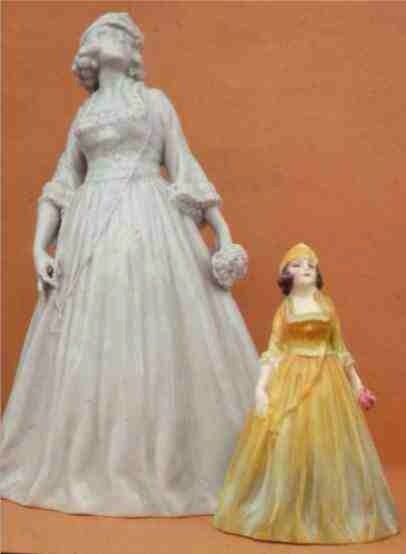
Doulton’s accurate representation of the famous American actress in the risqué play ‘Romance’ first performed in 1913 in the states before travelling to the UK two years later, proved a popular figure as you will see.

IMG_0330.JPG
A Lambeth version of Doris Keane together with her later, miniature self.

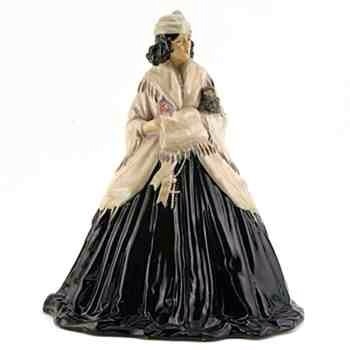
Doris plays an Italian opera singer, an over the top character who always wears black and carries a pet monkey.

IMG_0329.JPG
HN 96 with her carrying the pet monkey!

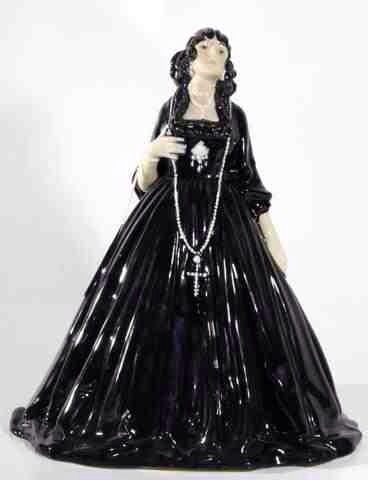
The story follows the ill fated love story of the opera singer and a clergyman. He gives her his mothers pearls and pendant – which can be seen in all versions of this figure – but she realises her past would ruin his career so the two part declaring their undying love.

IMG_0331.JPG
An unusual gloss version of HN 90 sold at Bonhams.

Their love scenes, the role of the clergyman and Doris’ undressing on stage made the play a transatlantic success! When she arrived in England she was mobbed and Romance played for over a thousand performances in London alone!

IMG_0332.JPG
An unusual hard paste porcelain body version of Doris Keane by John Broad ca.1919. The porcelain body was another invention of Lambeth’s art director Joseph Mott.

This Lambeth version of Doris Keane above would eventually be remodelled and produced in china at Burslem under the name Rosamund and as you can see also above a miniature version was also issued. The two earlier Burslem versions of Doris Keane as Cavallini HN90 & 96 were a monumental 26-28 cms tall, typical of early figures in the HN collection.

Collecting Royal Doulton Embossed Jugs

IMG_0291.JPG

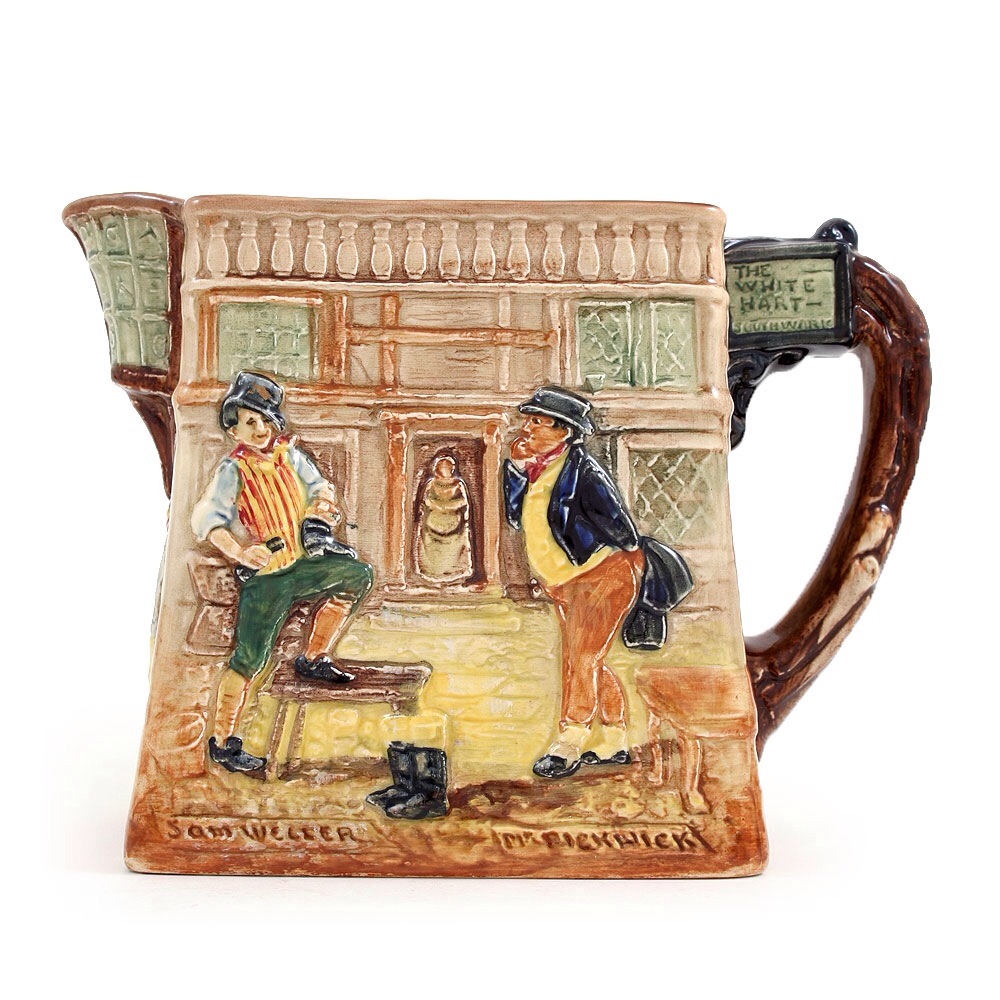
We have already looked at Royal Doulton’s ever popular series of a Limited Edition Loving Cups and Jugs, and this series of 7 smaller jugs fit perfectly with their larger, rarer counterparts.
First introduced in the same decade as the larger Jugs and Cups, this set of 7 bear out Charles Noke’s passion for Dickens.

IMG_0290.JPG
Here are the details for this charming set:
D5584 “Old Curiosity Shop” 1935-60
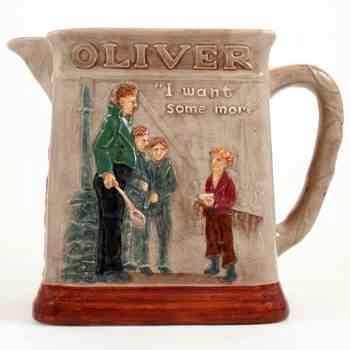
D5617 “Oliver Twist” 1936-60
D5756 “Pickwick Papers” 1937-60
D6285 “Oliver Asks For More” 1949-60
D6286 “Oliver Twist” tankard 1949-60
D6291 “Old London” 1949-60
D6292 “Peggoty” 1949-60

As always the last ones with the shorter production runs are the most difficult to find today, but a full collection is possible and they make a super display.
There were other relief or embossed Dickens wares but that is for another time! Happy collecting!

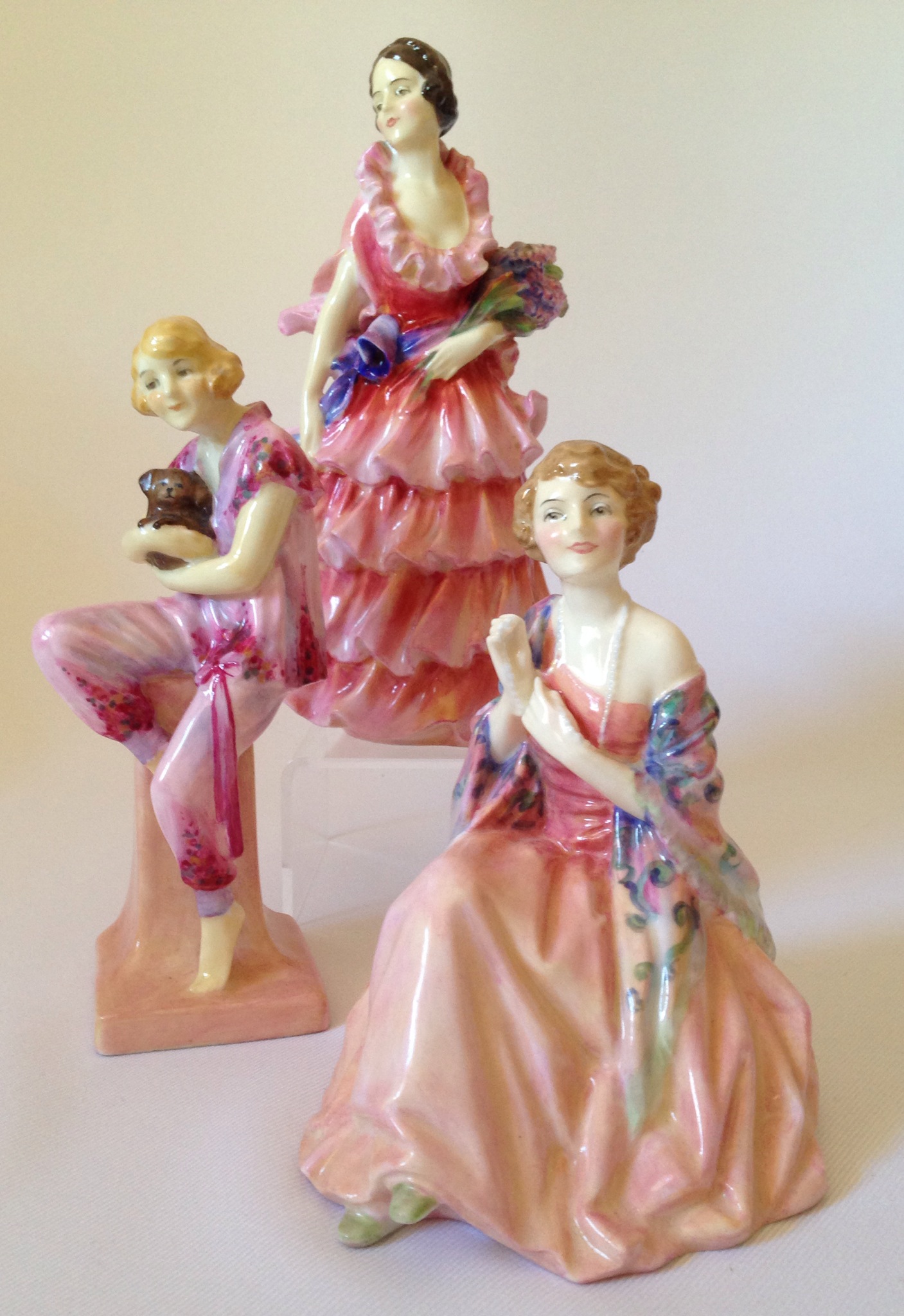
Royal Doulton’s perfect ‘pink’ ladies!

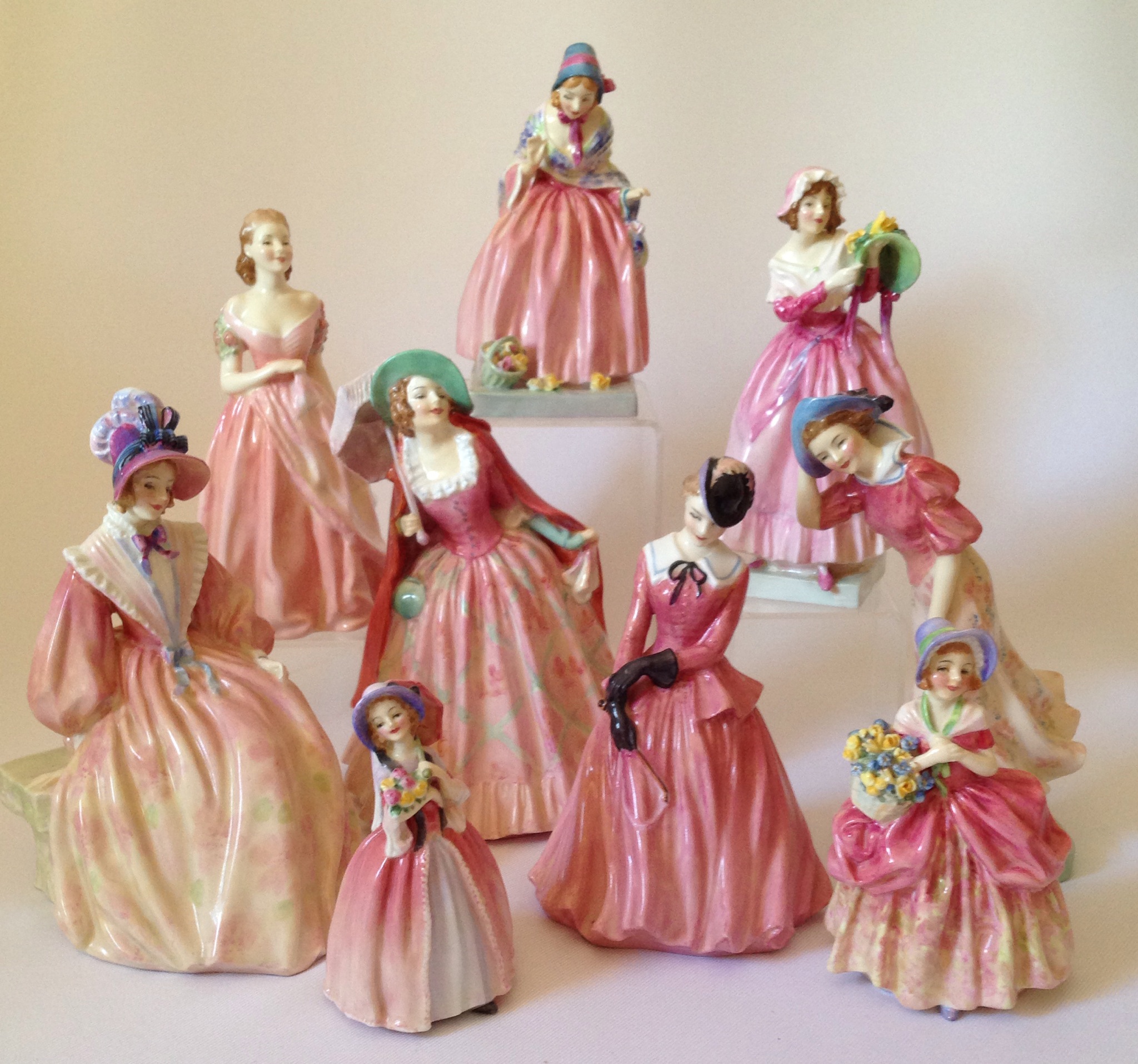
Continuing our look at ideas for arranging or grouping figures, here is a further colour theme – picture perfect pinks!

IMG_0283.JPG
A group of Harradine’s pink ladies.

The popularity of pink figures like many of the other colour themes we have looked at seems to have fluctuated over the years. Even today there are groups of pink figures that are introduced only for there to be a real gap in the issuing of further examples.

IMG_0284.JPG
Three early pink ladies.

However, some pink ladies remained popular for decades including Harradine’s pink Top o’ the hill HN1849 and many of his child studies including Cissie HN1809 and her partner Bo-Peep HN1811.

IMG_0285.JPG
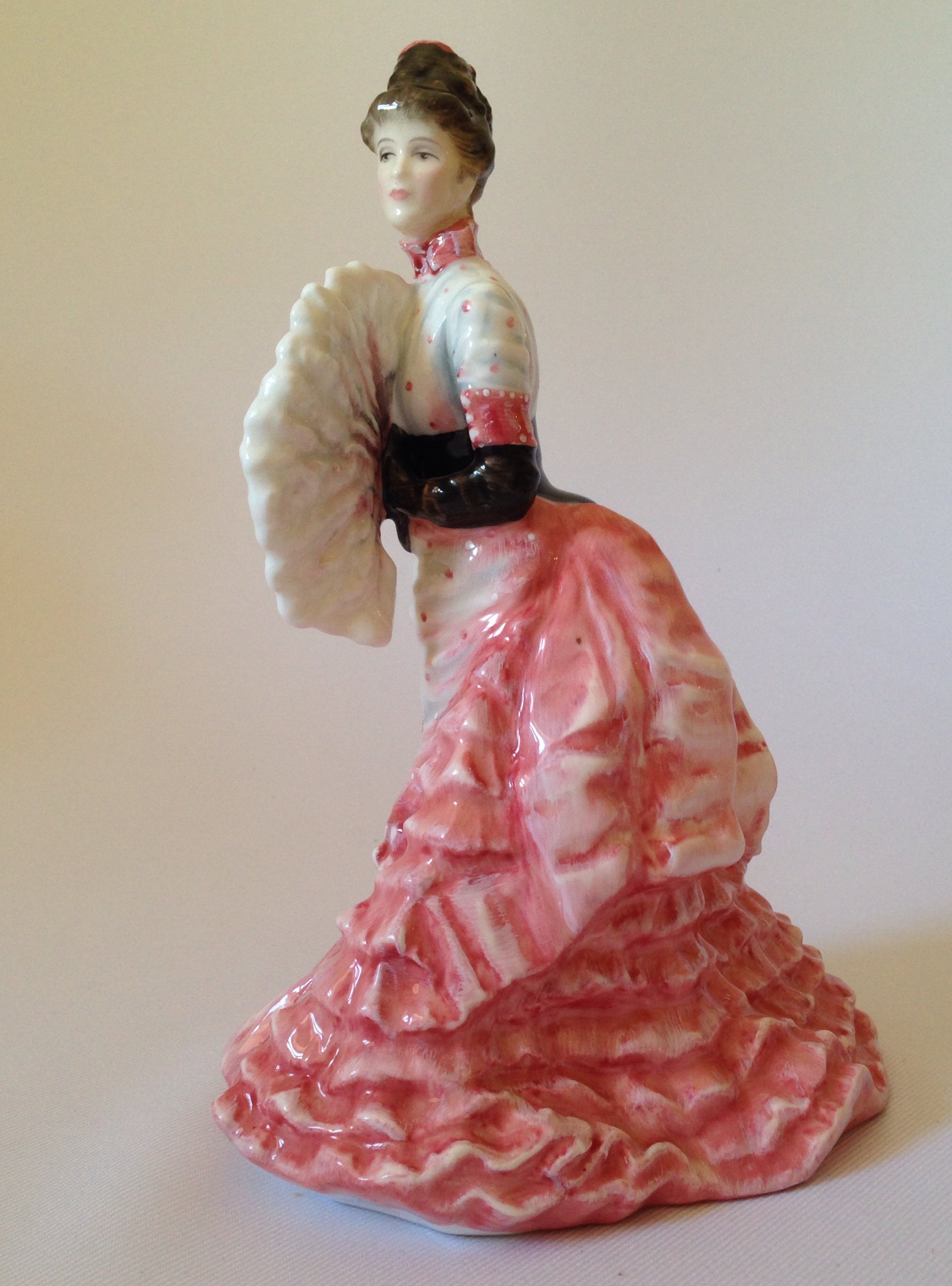
A selection of Peggy’s pink ladies.

Many of Harradine’s figures from the mid to late 1930’s were issued in either a pink or a blue colourway and the pink appears to have generally been preferred, meaning that today collectors really have to search assiduously for the blue versions of figures such as Miss Fortune, The Lambeth Walk, Windflower and Maureen to name but a few.

IMG_0287-0.JPG
Valerie Annand’s elaborate L’Ambitieuse from more recent times.

As always whatever your tastes a grouping of one colour or many colours makes an eye-catching display.

IMG_0288.JPG
Peggy’s beautiful figurine ‘Polka’.

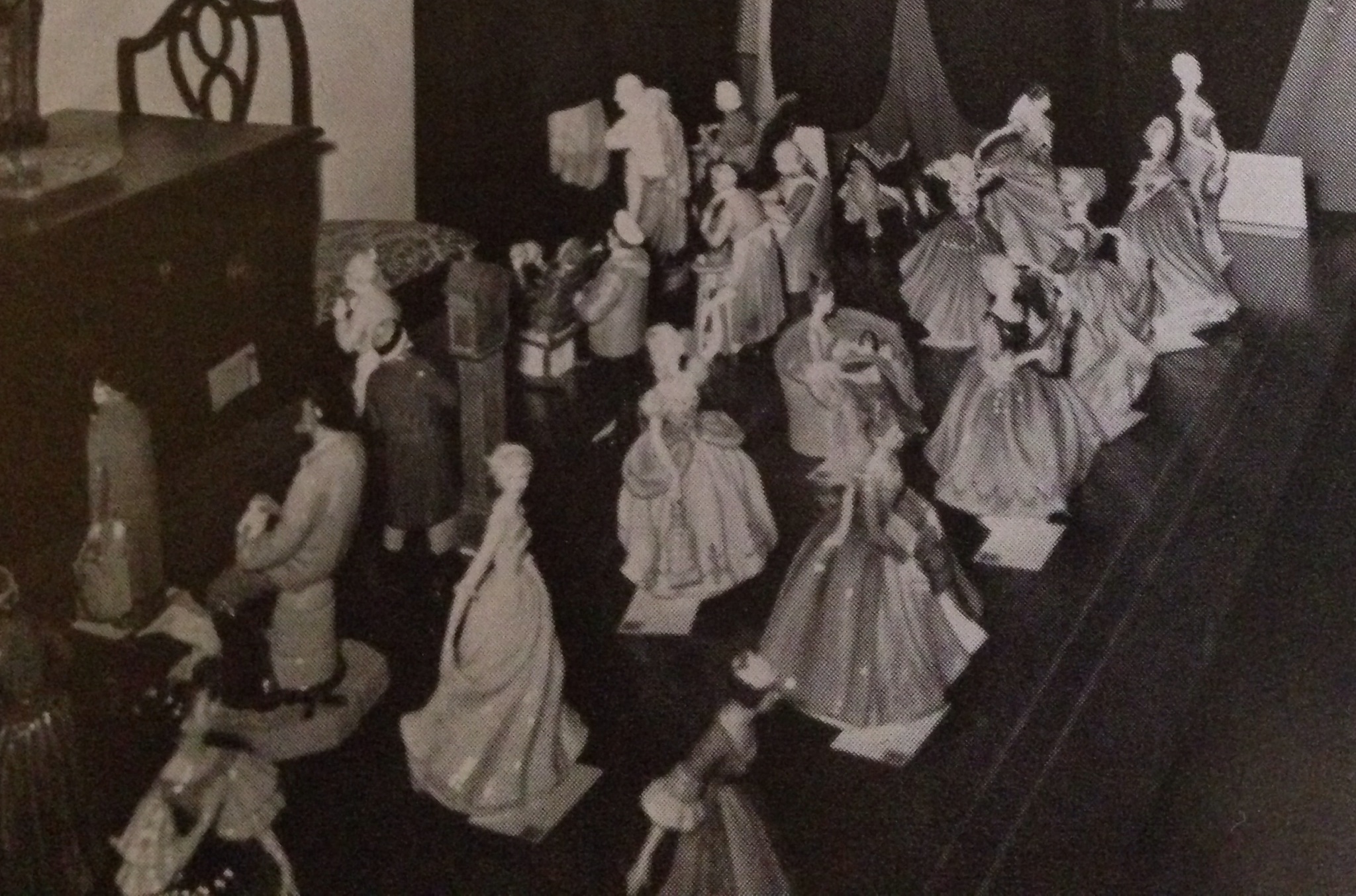
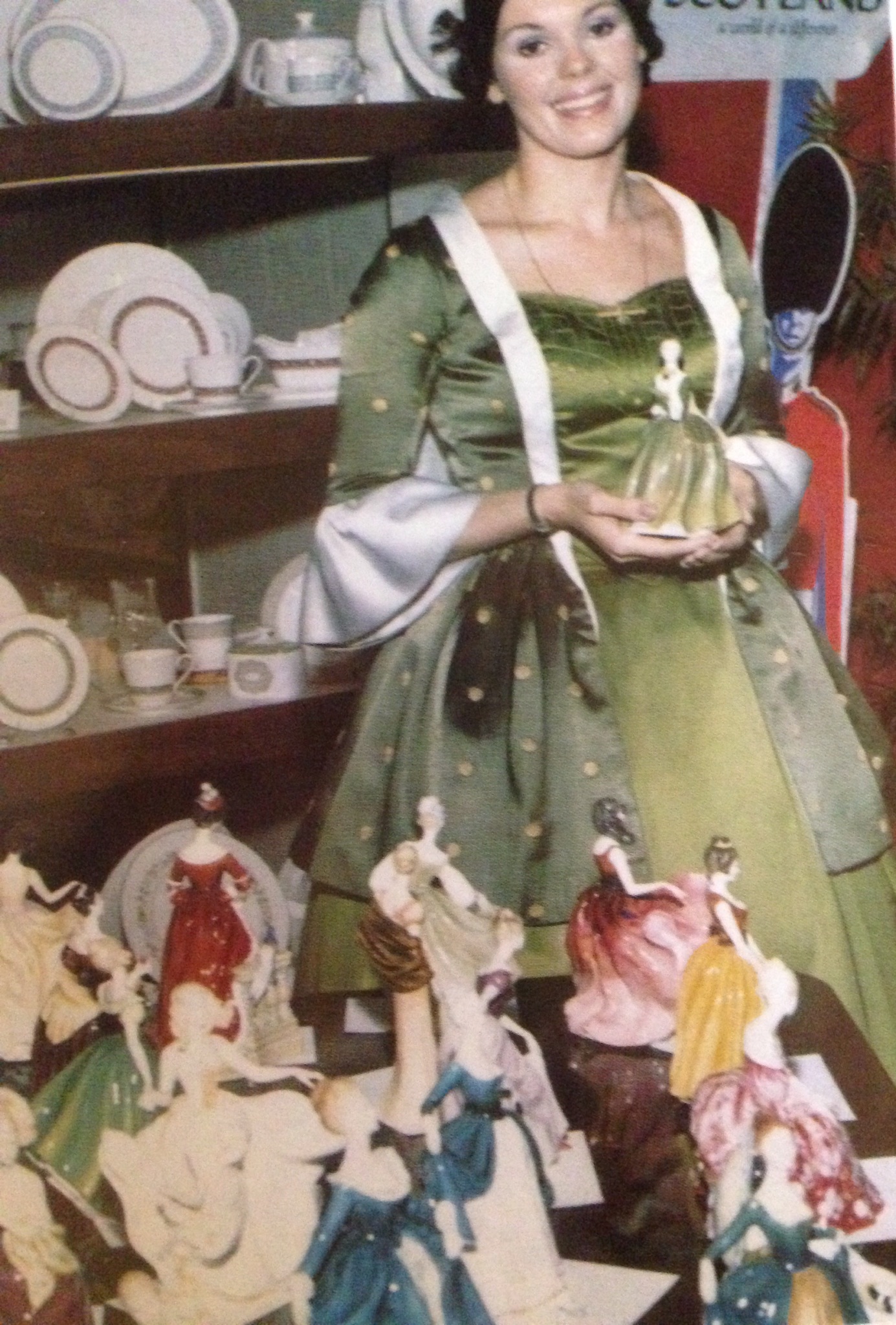
Royal Doulton’s figure surveys.

IMG_0188.JPG
A table of figures of which only a fraction were eventually produced.

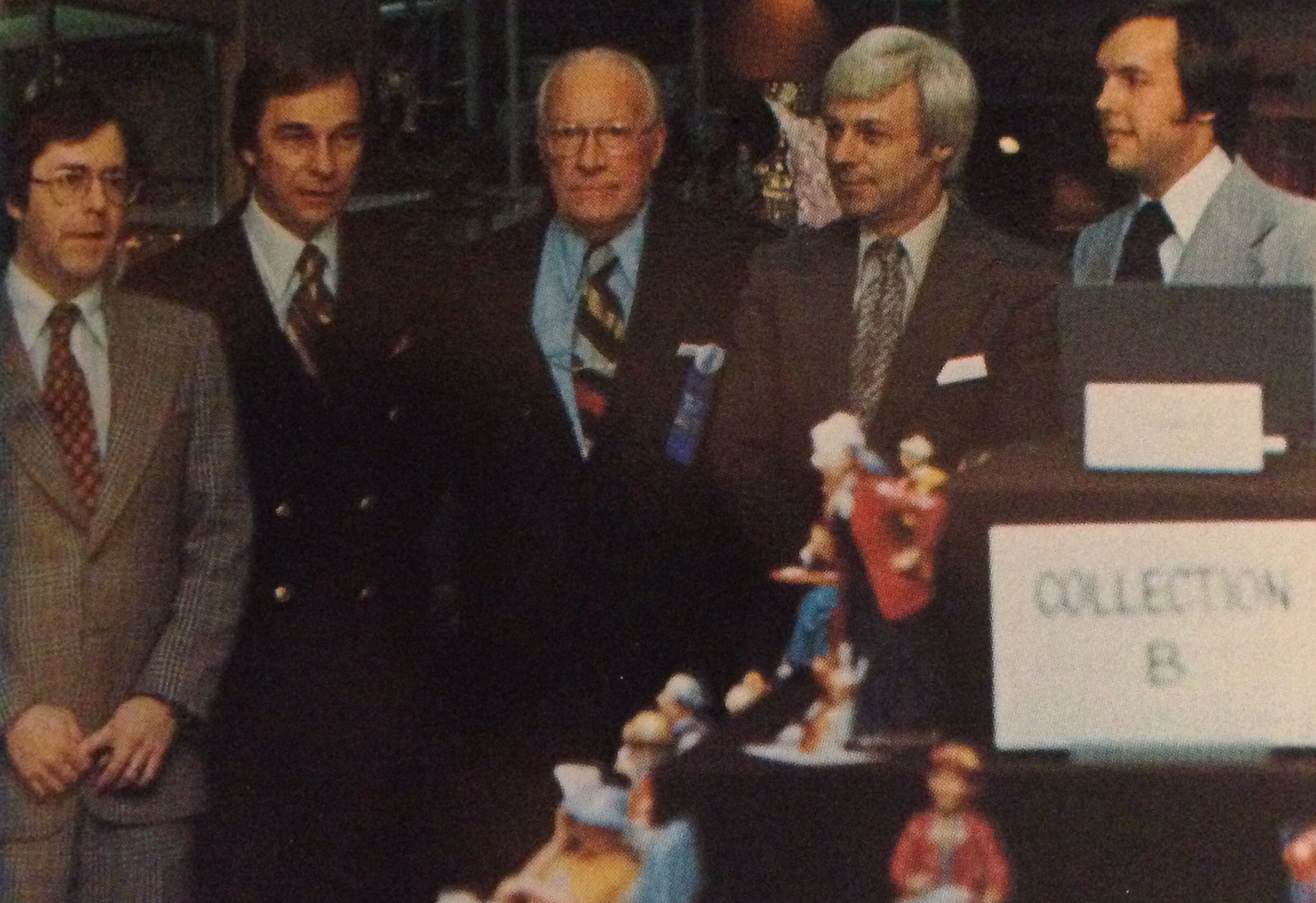
Prototypes and colourways have been the subject of previous articles, but I thought you all might like to see these few pictures I have come across of figure evaluation events. Typically these occurred in the US and Canada during the 1960’s-80’s.

IMG_0190.JPG
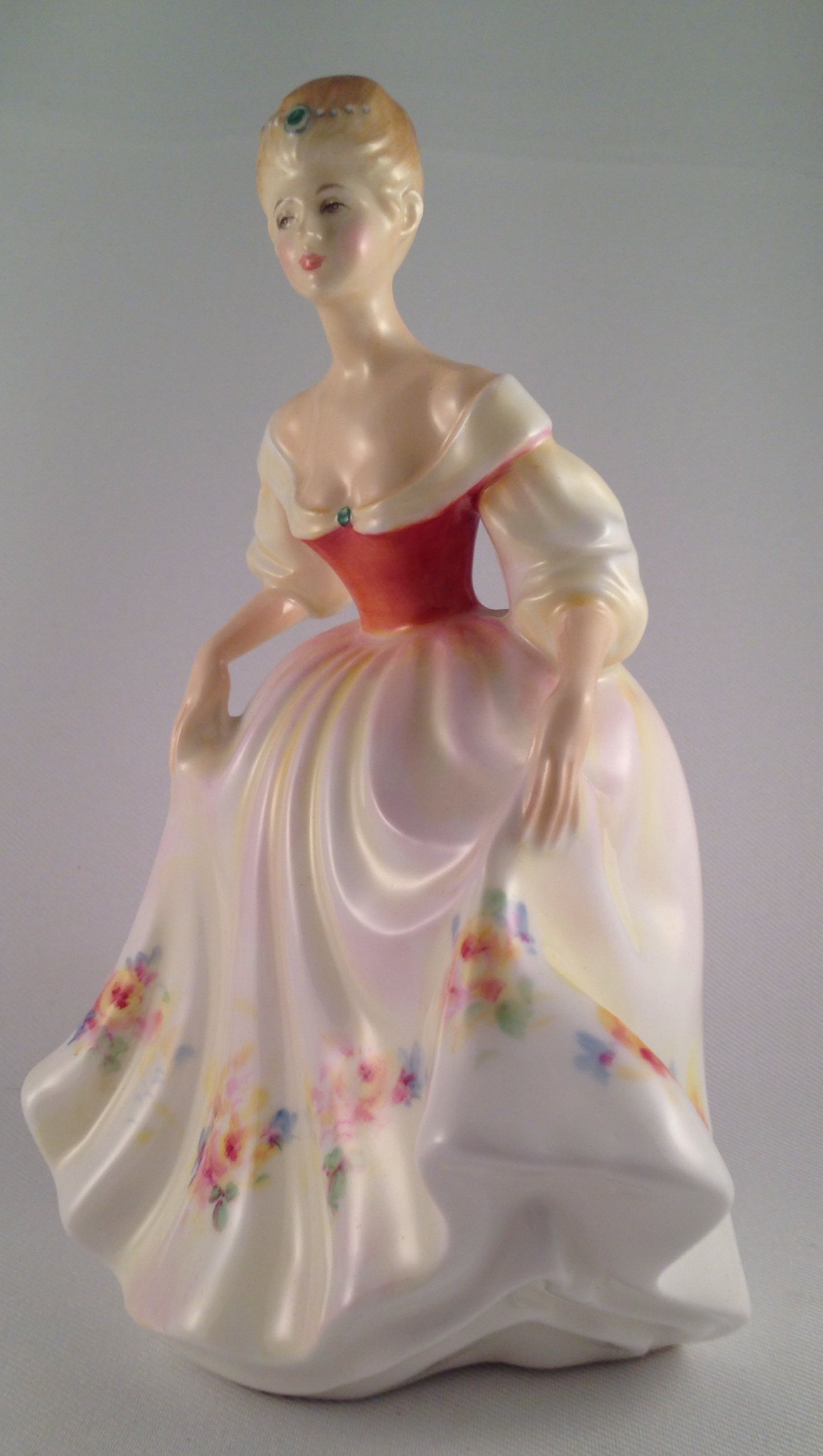
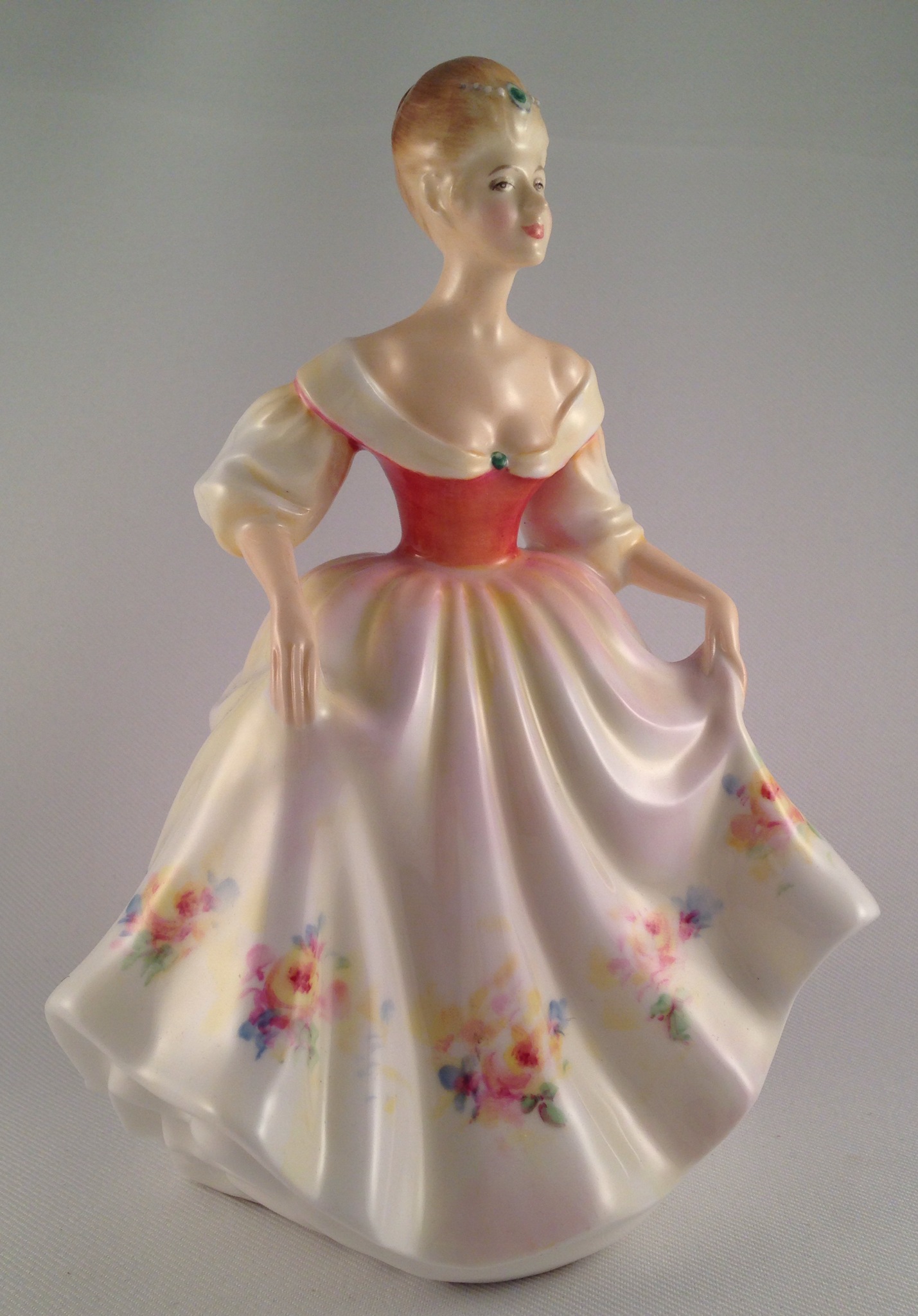
Another display featuring a wonderful red colourway of Sweet Seventeen that turned up at the Doulton museum sale in London.

At first security at such events appears to have been lax with figures ‘escaping’ during their travels, but as time went on Doulton began to appreciate what value these survey pieces had and storage even at the factory improved greatly. Indeed, Doulton ‘sat’ on prototypes for many years, sometimes decades as with the figure Elizabeth HN2465 from 1970 that was only out into production in 1990 or the handful of Mary Nicoll ladies such as Lesley that appeared many years after their original production. You can see some of these figures in the pictures shown here on this page.

IMG_0189.JPG
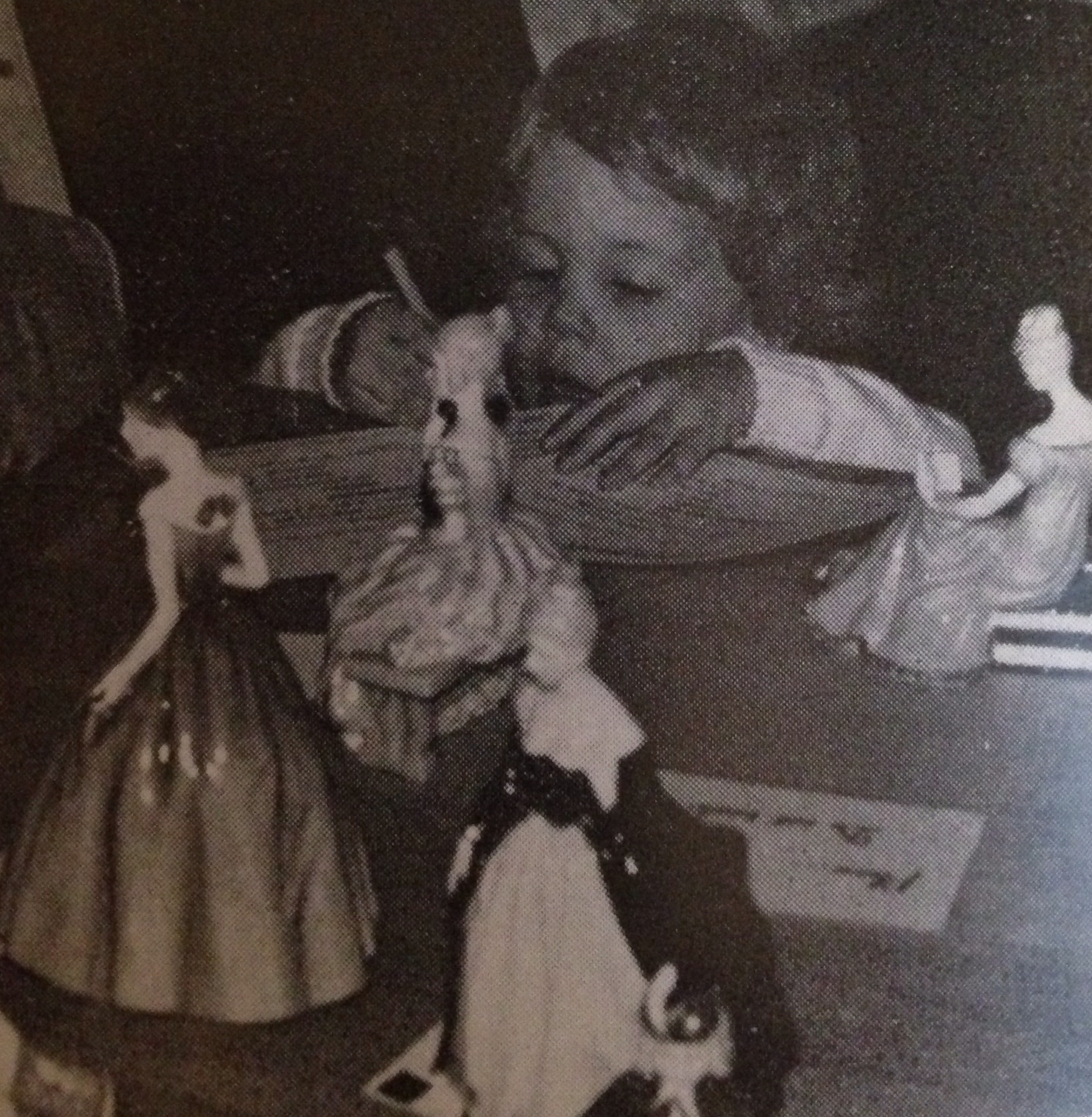
A young collector casts their vote for their favourites.

The majority of prototypes that turn up appear to be from the 1940’s onwards, indicating that the majority of models produced before this time were put into production – the length of production indicating popularity. Yet, earlier prototypes do turn up and whilst I have heard people say that all Harradine’s models went into production, this is not the case as even his models faced heavy scrutiny after 1940 and began not to go into production but would face market surveys.

IMG_0191.JPG
Not the best illustration but a lovely colourway of a favourite prototype by Mary Nicoll from 1971, titled ‘Smith minor’ right at the front of the picture. A figure of a young boy off to school sat on his trunk and holding his cricket bat.

Perhaps you have a survey figure in your collection? If so we would love to hear from you and why not post a picture to our Facebook page ‘Doulton Collectors Club’!
Doulton artist profile – Edwin (Tim) Leigh.

A chance finding of this early colourway from 1968 encouraged me to do a little more research into her painter, Edwin Leigh, more usually known as Tim Leigh. His monogram however, remained EL.

IMG_0177.JPG
Above and below, two views of the colourway.

IMG_0178.JPG
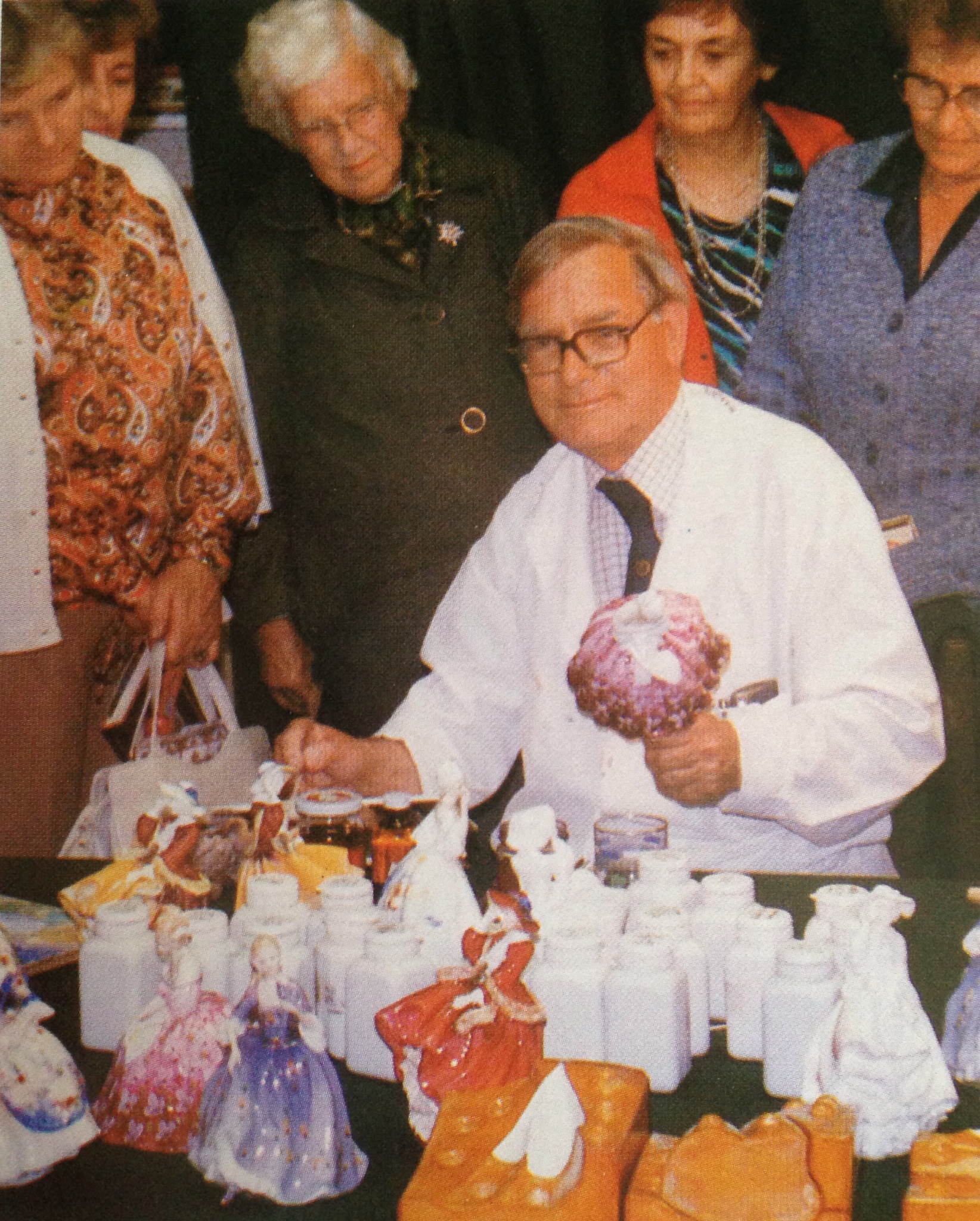
Tim began working at Doultons in 1928 and was still touring the world on their behalf promoting their wares and the artistry and skill of Doulton’s craftsmen and women, when this picture was taken of him during this demonstration in Australia in 1979.

IMG_0184.JPG
During his many decades of service, I found that by 1955 Tim was already in charge of the junior male figure painters.
A quick look through my collection I found several favourites painted by him including Celia, Miss Demure, Fleurette, Clemency and Sweet Anne to name but a few.
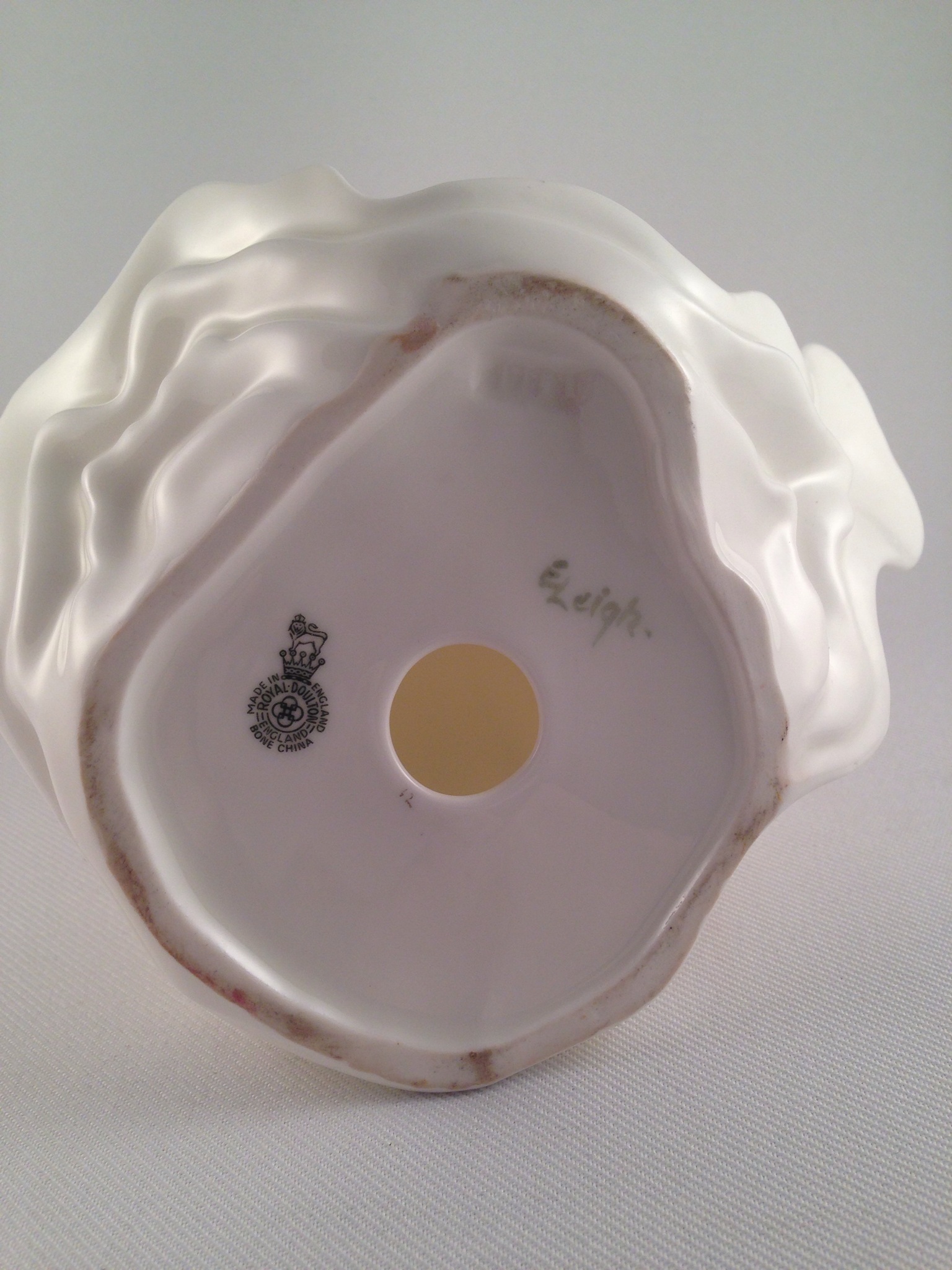
This great talent lives on in the many figures painted by him around the world. To finish here is his full signature on the base of the colourway above, rather than his usual cypher.

IMG_0179.JPG
The base of the above colourway also showing the model number 2063 that helps us date it to the late 1960’s.

Reflections: the source of Harradine’s popular figure Phyllis.

As you know it is a real interest of mine to research where figures derive their inspiration. Those who have read my book ‘Reflections’ with Jocelyn, will have seen the section on the illustrator Jennie Harbour.

IMG_0161.JPG

Very little is known about the illustrator but her work can be found on Tuck’s postcards as well as in many editions of deco books from the time. Her illustrations remain popular today around the world and framed, vintage prints can sell for a fair sum.

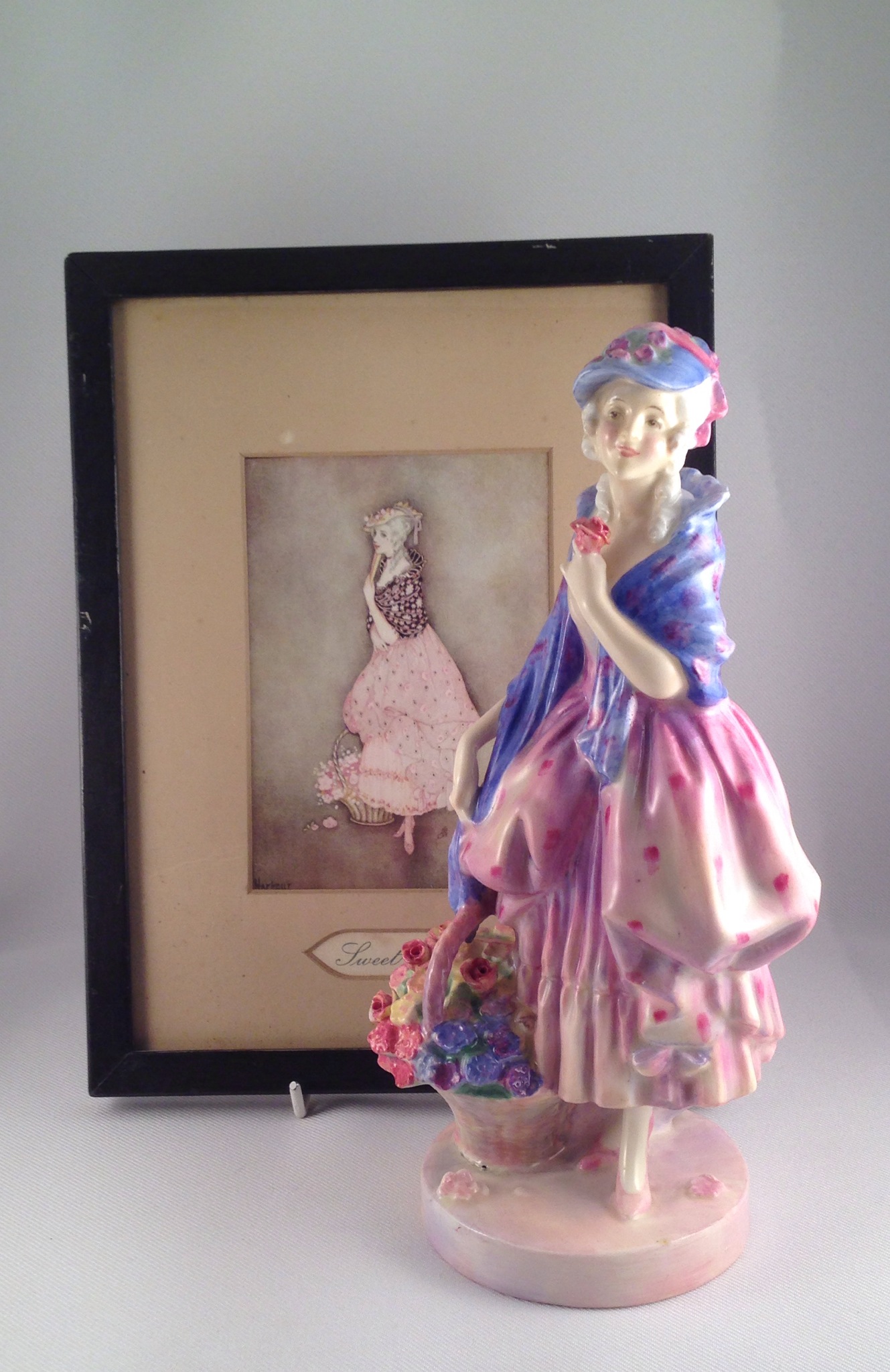
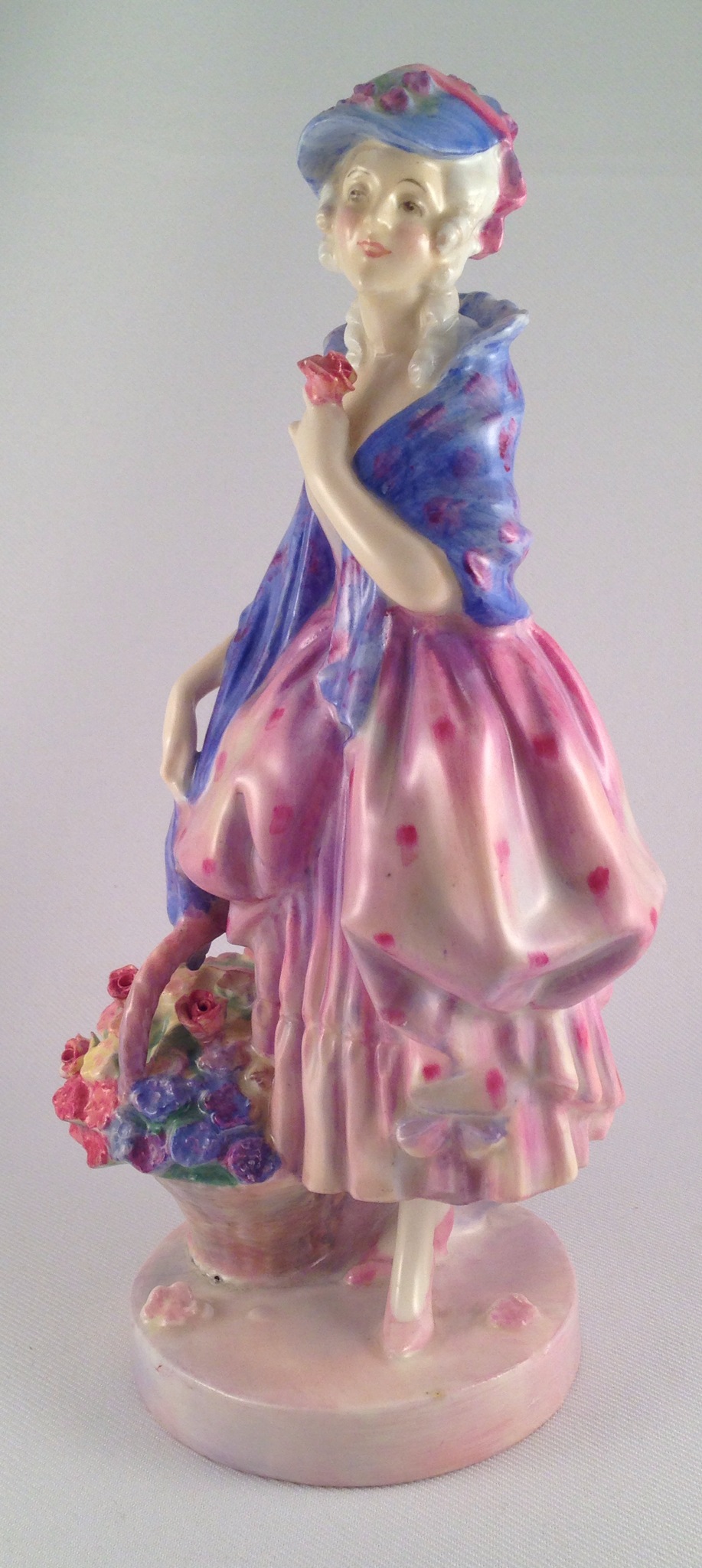
Back to Phyllis, as you can see she has been expertly interpreted from Jennie Harbour’s illustration ‘Sweet Nell’ by Harradine. Here she is as HN1486, although the most readily found version is HN1420 as it was clearly the most popular colourway. I have always felt that she makes the perfect partner to Dolly Vardon save for the base on Phyllis. Perhaps there is a version if Phyllis out there without a base. As we know modifications were frequent on these early figures, and we looked at how a stepped vase was added to Harradine’s Helen some time ago.

IMG_0164.JPG

Royal Doulton’s dreamy yellow and orange figures.

IMG_0141.JPG

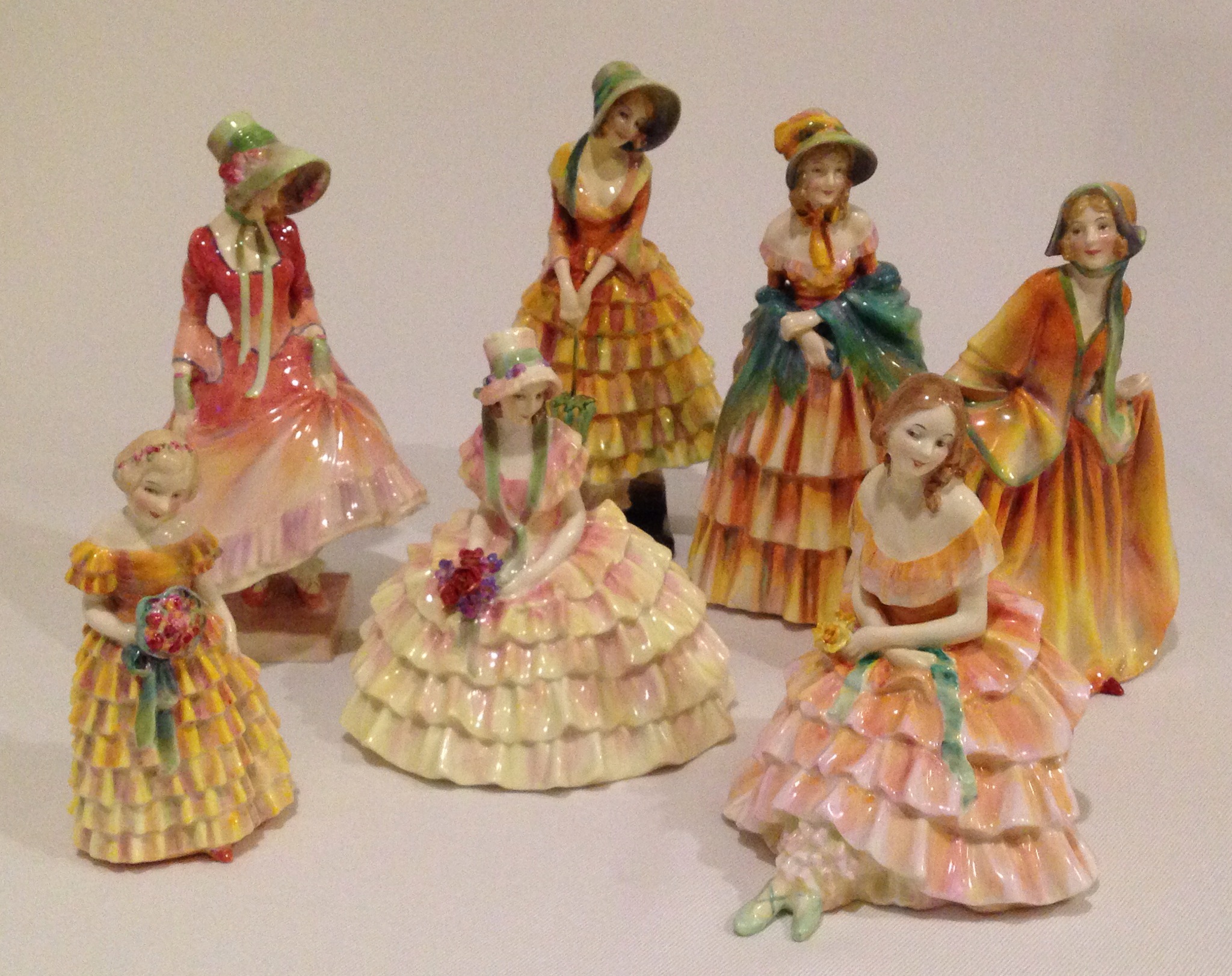
We all normally associate bright reds, blues and greens with Doulton figures, however, there were a small group of early figures that fit into the peachy, yellow-orange bracket as you can see above.

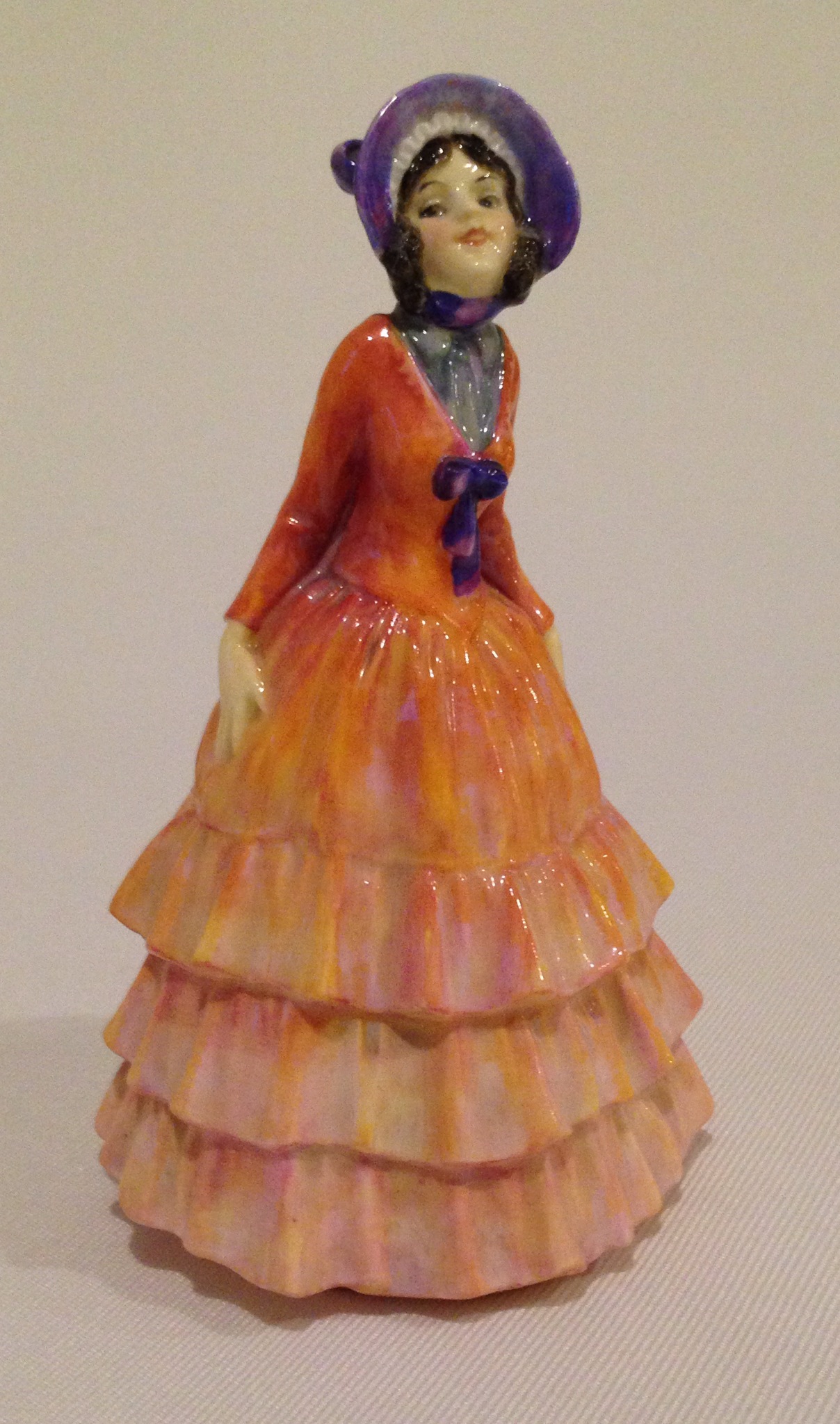
The majority of these figures have HN numbers around 1500, indeed the colourway of Sweet Anne pictured actually carries the HN number 1529, an HN number we associate with the colourway of A Victorian Lady – also pictured above. This group of ladies are typically finished with green accessories; usually a gorgeous hue of green to compliment the yellowy orange colouring. The wonderful thing about these ladies is the depth of the colouring involved – a real forte of the Doulton painters of the time who would re-fire the colours multiple times to achieve the desired effect.

This demure band of ladies are all colour co-ordinated, yet, there are others we can add to this dreamy crowd. Here is a colourway of Pauline in orange.

IMG_0142.JPG

Perhaps you too own figures that belong to this group. If so why not share them via our facebook page ‘Doulton Collectors Club’. We look forward to welcoming you!

A look back at the enduringly popular Flower Seller’s Children.

IMG_0140.JPG
A close up of the skilfully painted children’s faces.

This delightful study was the concept of Leslie Harradine in 1921 during his first year of supplying models to Doulton’s studios in Burslem. Harradine had been apprenticed to Doulton in Lambeth in the early years of the 20th Century but factory life he found unbearable and so broke loose from these confines. He continued to supply models to Lambeth’s studios until his departure for Canada. This early time in Harradine’s association with Doulton we have covered already in the three part article on his life.

IMG_0139.JPG
HN1206 1926-1943

Upon his return Charles Noke, Burslem’s art director, tried every enticement to attract Harradine to move to the Potteries but to no avail. A compromise was of course reached whereby he would supply models to Burslem, something that continued for many decades.
This early group by Harradine was available in 5 different colourways and one HN1342 was produced until 1993. Whilst not classed as a prestige piece the painting that can be found on these pieces is stunning as I am sure you will agree.
Harradine’s inspiration for this piece apparently came during an evening out in London, whereupon he saw such a scene and sketched it upon his shirt sleeve. A romantic story for a sentimental group.
The enduring charm of this study meant that a collectors plate and more recently a miniature version of this group HN4807 was introduced in 2005.